News

Searching for distant and wandering worlds

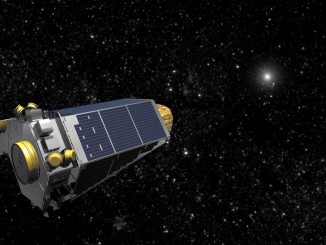
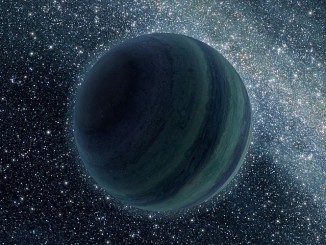
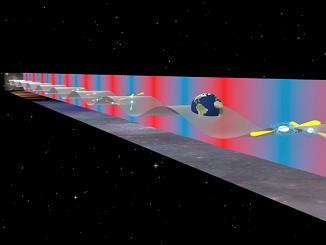
In a global exoplanet observation experiment, NASA’s Kepler K2 mission and Earth-based observatories on six continents hope to survey millions of stars toward the centre of our Milky Way galaxy. Using a technique called gravitational microlensing, scientists will hunt for exoplanets that orbit far from their host star and for free-floating exoplanets that wander between the stars.

News

Where are the missing brown dwarfs?

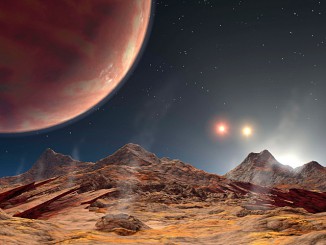
Brown dwarfs are objects that are too large to be called planets, yet too small to shine by nuclear fusion. Two German researchers have taken a careful look at the distribution of nearby examples of these “failed stars” and to their surprise discovered a significant asymmetry in their spatial arrangement.

News

Supermassive black hole found in an unlikely place

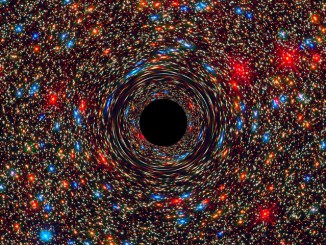
A near-record 17-billion-solar-mass black hole discovered in a sparse area of the local universe indicates that these monster objects may be more common than once thought. The newly discovered supermassive black hole is in NGC 1600, an elliptical galaxy in the constellation Eridanus some 149 million light-years away.

News

Supernovae showered Earth with radioactive iron

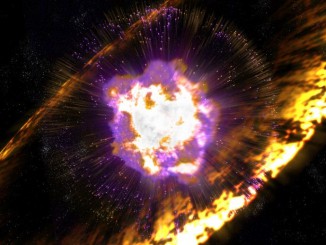
An international team of scientists has found radioactive iron-60 in sediment and crust samples taken from the Pacific, Atlantic and Indian Oceans. They report that a series of massive supernova explosions occurring between 3.2 and 1.7 million years ago from stars less than 300 light-years away showered the Earth with radioactive debris.

News

Early Mars bombardment likely enhanced its habitability

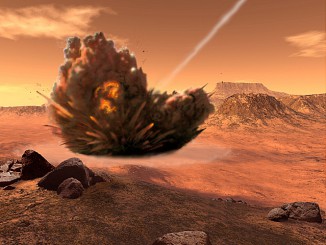
Much of the action on Mars occurred during a period known as the Late Heavy Bombardment about 3.9 billion years ago. Large comets and asteroids raining down on the planet would have produced enough heat to melt subsurface ice, likely enhancing climate conditions enough to make Mars more conducive to life — at least for a time.