News

Light echoes give clues to young star’s protoplanetary disc

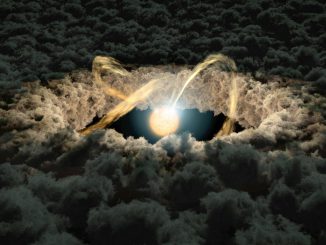
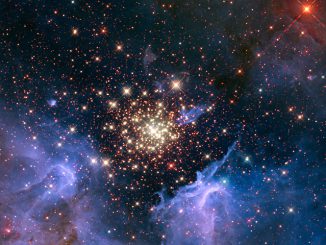
Protoplanetary discs are ‘doughnuts’ of gas and dust surrounding young stars, the sites where planets form over the course of millions of years. Researchers studying the one-million-year-old infant star YLW 16B, some 400 light-years from Earth, were able to determine the distance from the star to the inner rim of its surrounding protoplanetary disc by observing its light echo.

News

Hubble discovers moon orbiting the dwarf planet Makemake

NASA’s Hubble Space Telescope has spotted a small, dark moon orbiting Makemake, the second brightest icy dwarf planet — after Pluto — in the Kuiper Belt. The moon, provisionally designated S/2015 (136472) 1 and nicknamed MK 2, is estimated to be 100 miles in diameter. Makemake and its moon are more than 50 times farther away than Earth is from the Sun.

News

Martian surface revealed in unprecedented detail

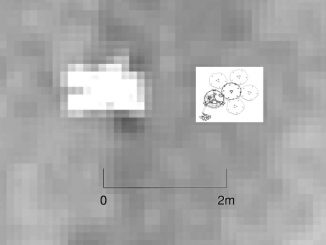
The surface of Mars — including the location of Beagle-2 — has been shown in unprecedented detail by University College London scientists using a revolutionary image stacking and matching technique. The UCL researchers used the Super-Resolution Restoration (SRR) process to reveal objects at a resolution up to five times greater than previously achieved.

News

Lone planetary-mass object found in a young star family

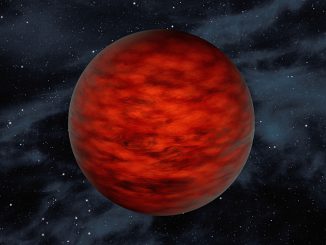
Astronomers have found a free-floating object called WISEA 1147, thought to be an exceptionally low-mass “brown dwarf,” which is a star that lacked enough mass to burn nuclear fuel and glow like a star. Reasearchers using data from NASA’s WISE and 2MASS sky surveys found the object in TW Hydrae — a young, 10-million-year-old association of stars.

News

Swansong experiment sheds light on Venus’ polar atmosphere

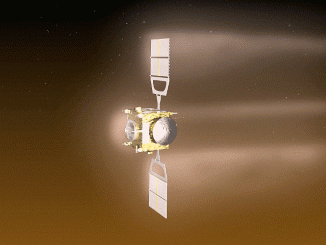
Some of the final results sent back by ESA’s Venus Express before it plummeted down through the planet’s atmosphere have revealed it to be rippling with atmospheric waves and, at an average temperature of -157 °C, colder than anywhere on Earth. The aerobraking experiment has improved our knowledge of our planetary neighbour and holds great promise for ESA’s forthcoming ExoMars mission.