
News


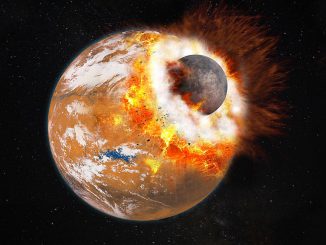
Where did the two natural satellites of Mars, Phobos and Deimos, come from? For a long time, their shape suggested that they were captured asteroids. However, the shape and course of their orbits contradict this hypothesis. Two independent and complementary studies now provide an answer: these satellites formed from the debris of a gigantic collision between Mars and a protoplanet one-third its size.
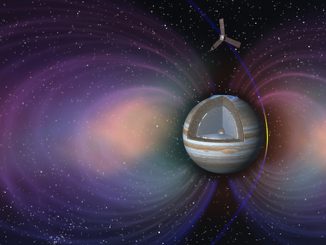

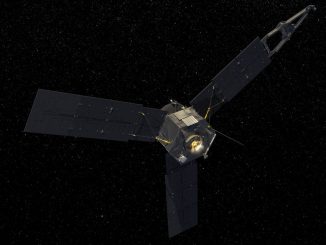
NASA’s Juno spacecraft is barreling toward a rendezvous with Jupiter after a 2.8 billion kilometre (1.7-billion-mile), five-year trip from planet Earth. The research probe’s main engine will ignite for 35 minutes to maneuver Juno into orbit, and engineers expect to receive confirmation of burn’s start at 0318 GMT Tuesday.
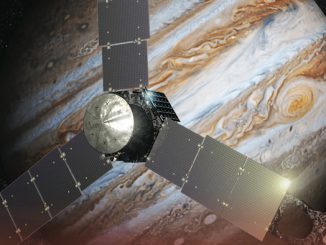
Whether you’re a casual stargazer or armed with a toolkit of observing gadgets, chances are you have caught a glimpse of Jupiter this year beckoning as one of the brightest objects in the night sky. It’s about to get its first visitor in nearly a decade, when NASA’s Juno spacecraft rockets into orbit.
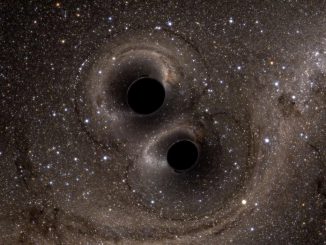
Researchers at the University of Cambridge have developed a new method for detecting and measuring one of the most powerful, and most mysterious, events in the universe — a black hole being kicked out of its host galaxy and into intergalactic space at speeds as high as 5,000 kilometres per second (11 million miles per hour).
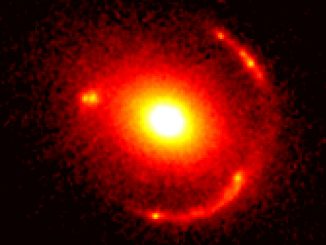
Due for launch in 2020, ESA’s Euclid satellite will set astronomers a huge challenge: to analyse 100,000 strong gravitational lenses. The gravitational deflection of light from distant astronomical sources by interposing massive galaxies can create multiple images of the source that are not just visually stunning, but are also valuable tools for probing our universe.
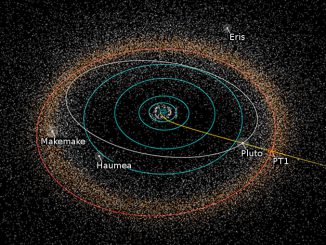
Following its historic first-ever flyby of Pluto, NASA’s New Horizons mission has received the green light to fly onward to an object deeper in the Kuiper Belt, known as 2014 MU69. The spacecraft’s planned rendezvous with the ancient object — considered one of the early building blocks of the solar system — is 1 January 2019.
© 2026 Nebula Press Ltd