News
Did early Earth spin on its side?
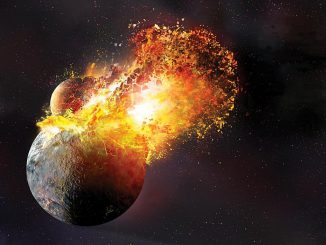
New theoretical modelling of the ancient history of the Earth and the Moon suggests that the giant collision that spawned our natural satellite may have left Earth spinning very fast, and with its spin axis highly tilted. The simulations give new insight into the question of whether planets with big moons are more likely to have moderate climates and life.
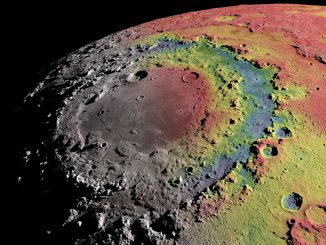
Lunar impact: how the Moon’s Mare Orientale was formed
The Moon’s Orientale basin is an archetype of “multi-ring” basins found throughout the solar system. New research has enabled scientists to reconstruct Orientale’s formation using data from NASA’s GRAIL mission. It is now thought that the 580-mile-wide feature was created 3.8 billion years ago by an impacting object some 40 miles across travelling at about 9 miles per second.
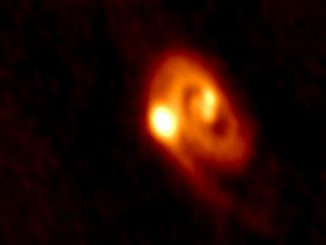
ALMA witnesses the birth of a triple-star system
A rare triple-star system surrounded by a disc with a spiral structure has been discovered by a global team of researchers. Recent observations from the Atacama Large Millimetre / submillimetre Array (ALMA) resulted in the discovery, lending support for evidence of disc fragmentation — a process leading to the formation of young binary and multiple star systems.
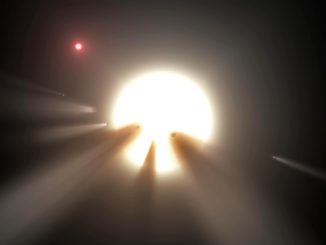
Breakthrough Listen to search for intelligent life around weird star
Tabby’s star, otherwise known as KIC 8462852, has provoked so much excitement over the past year, with speculation that it hosts a highly advanced civilisation capable of building orbiting megastructures, that UC Berkeley’s Breakthrough Listen project is devoting hours of time on the Green Bank radio telescope to see if it can detect any extraterrestrial signals.
Unexpected gaseous haloes detected around distant quasars
An international team of astronomers has discovered glowing gas clouds surrounding distant quasars. The new survey of these active galaxies indicates that haloes around quasars are far more common than expected. The properties of the haloes in this surprising find are also in striking disagreement with currently accepted theories of galaxy formation in the early universe.
Mysterious flaring X-ray objects discovered in nearby galaxies
Astronomers have found a pair of extraordinary cosmic objects that dramatically burst in X-rays, flaring up to become about a hundred times brighter in less than a minute, before returning to original X-ray levels after about an hour. This discovery may represent a new class of explosive events found in space.
Hotspots in Cygnus A: an active galactic nucleus
Newly obtained radio images of the dramatic bipolar jets of charged particles being ejected from the nucleus of galaxy Cygnus A were able to resolve hotspots in the jets at the places where they impact the surrounding medium. A bright radio galaxy such as this can beam as much as one trillion solar luminosities of radiation into space at those wavelengths.
Low-mass star simulations favour water-rich, Earth-sized planets
Astrophysicists at the University of Bern conducting computer simulations of the formation of planets orbiting in the habitable zone of low-mass stars, such as the red dwarf Proxima Centauri, show that these planets are most likely to be roughly the size of the Earth and to contain large amounts of water.