News

New theory of gravity might explain dark matter

Emergent gravity is a new theory that might explain the curious motions of stars in galaxies. It predicts the exact same deviation of motions that is usually explained by invoking dark matter. Professor Erik Verlinde, renowned expert in string theory, publishes a new research paper today in which he expands his groundbreaking views on the nature of gravity.

News

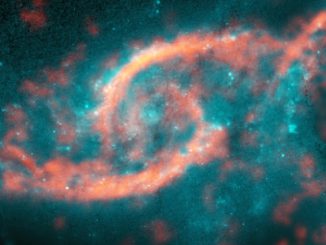
Interacting galaxies produce eye-shaped “tsunami” of stars

Astronomers using the Atacama Large Millimetre/submillimetre Array (ALMA) have discovered a tsunami of stars and gas that is crashing midway through the disc of a spiral galaxy known as IC 2163. This colossal wave of material — which was triggered when IC 2163 recently sideswiped another spiral galaxy dubbed NGC 2207 — produced dazzling arcs of intense star formation that resemble a pair of eyelids.

News

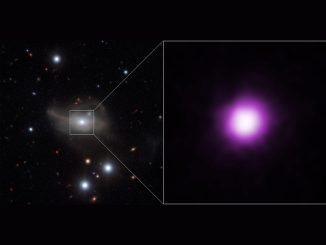
Galactic merger exposes supermassive black hole

Astronomers using the super-sharp radio vision of the National Science Foundation’s Very Long Baseline Array (VLBA) have found the shredded remains of a galaxy that passed through a larger galaxy, leaving only the smaller galaxy’s nearly-naked supermassive black hole to emerge and speed away at more than 2,000 miles per second.

News

Supercomputer comes up with profile of dark matter

In the search for the mysterious dark matter, physicists have used elaborate computer calculations to come up with an outline of the particles of this unknown form of matter. The scientists extended the successful Standard Model of particle physics which allowed them, among other things, to predict the mass of so-called axions, promising candidates for dark matter.

News

Relationship revealed between chemicals found on comets

A new study reveals similarities and relationships between certain types of chemicals found on 30 different comets, which vary widely in their overall composition compared to one another. The research is part of ongoing investigations into these primordial bodies, which contain material largely unchanged from the solar system’s birth some 4.6 billion years ago.

News

‘Pillars of destruction’ in the Carina Nebula

Spectacular new observations of vast pillar-like structures within the Carina Nebula have been made using the MUSE instrument on ESO’s Very Large Telescope. The different pillars analysed by an international team seem to be pillars of destruction — in contrast to the name of the iconic Pillars of Creation in the Eagle Nebula, which are of similar nature.