News

“Planetary Nebulae” receive more meaningful physical presence

Despite their name, planetary nebulae have nothing to do with planets. They were described as such by early astronomers whose telescopes showed them as glowing disc-like objects, but we now know that they represent the final stage of activity of stars like our Sun. A way of estimating more accurate distances to planetary nebulae dispersed across our Galaxy has just been announced.

Picture This

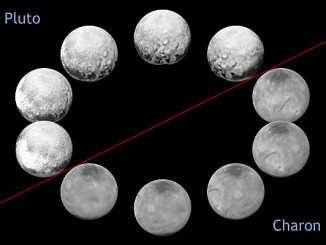
A day on Pluto, a day on Charon

Pluto’s day is 6.4 Earth days long. The dwarf planet’s largest moon, Charon, also rotates once every 6.4 days as the two worlds are tidally locked to each another. This sequence of images from the Long Range Reconnaissance Imager (LORRI) and the Ralph/Multispectral Visible Imaging Camera on NASA’s New Horizons spacecraft shows us full rotations of the two bodies.

Picture This

A supermassive black hole in action

Scientists often use the combined power of multiple telescopes to reveal the secrets of the universe — and this image of elliptical galaxy Hercules A is a prime example of when this technique is strikingly effective. Radio observations with the Karl G. Jansky Very Large Array were combined with the Hubble visible-light data obtained with the Wide Field Camera 3 to create this striking composite image.

News

Dark matter dominates in nearby dwarf galaxy

Dark matter is called “dark” for a good reason. Although they outnumber particles of regular matter by more than a factor of 10, particles of dark matter are elusive. Now, by measuring the mass of a nearby dwarf galaxy called Triangulum II, astronomers believe they may have found the highest concentration of dark matter in any known galaxy.