News

Making galactic history with first global age map of the Milky Way

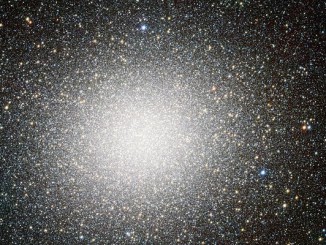
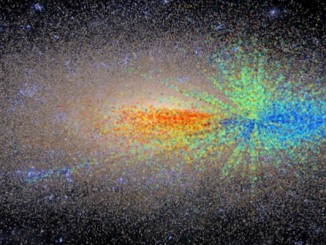
Astronomers have created the first large-scale map that shows stellar ages in the Milky Way by determining the ages of nearly 100,000 red giant stars, at distances of up to 50,000 light-years from the galactic centre. Notably, the map confirms that our home galaxy has grown inside out: in the present epoch, most old stars can be found in the middle, more recently formed ones in the outskirts.
News

Most distant massive galaxy cluster identified

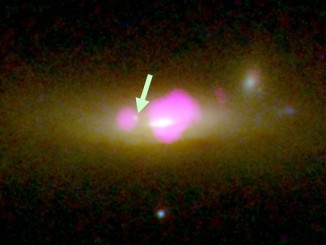
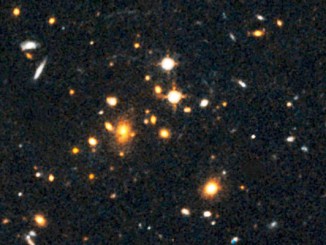
The early universe was a chaotic mess of gas and matter that only began to coalesce into distinct galaxies hundreds of millions of years after the Big Bang. It would take several billion more years for such galaxies to assemble into massive galaxy clusters — or so scientists had thought. Now astronomers have detected a massive, sprawling, churning galaxy cluster that formed only 3.8 billion years after the Big Bang, some 10 billion light years from Earth.

News

Galaxy quakes could improve hunt for dark matter

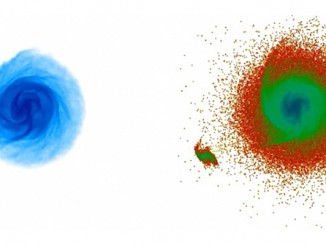
Ripples in gas at the outer disc of our galaxy have puzzled astronomers since they were first revealed by radio observations a decade ago. Now, astronomers believe they have found the culprit — a dwarf galaxy, containing dark, unseen material, which skimmed the outskirts of the Milky Way a few hundred million years ago. This method to characterise dark matter marks first real application of galactoseismology.

News

Space telescopes find “twins” of Eta Carinae in other galaxies

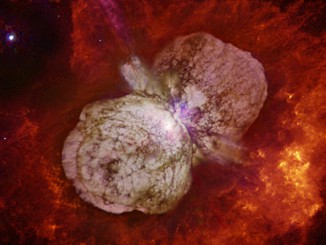
Located about 7,500 light-years away in the southern constellation of Carina, Eta Carinae outshines our Sun by 5 million times. The binary system consists of two massive stars in a tight 5.5-year orbit, shrouded in an expanding veil of gas and dust from an enormous eruption seen in the 1840s. Now a study using archival data from NASA’s Spitzer and Hubble space telescopes has found five similar objects in other galaxies for the first time.

News

Runaway stars leave infrared waves in space

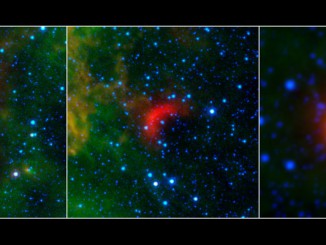
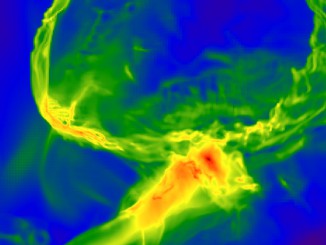
Astronomers are finding dozens of massive, so-called ‘runaway stars’ in our galaxy with the help of images from NASA’s Spitzer Space Telescope and Wide-field Infrared Survey Explorer, or WISE. When these speedy, massive stars plow through space, they can cause material to stack up in front of them, creating dramatic arc-shaped features called bow shocks.

News

Andromeda Galaxy scanned with high-energy X-ray vision

NASA’s Nuclear Spectroscopic Telescope Array, or NuSTAR, has captured the best high-energy X-ray view yet of a portion of the Andromeda Galaxy, our nearest large neighbouring spiral galaxy. The space observatory has observed 40 “X-ray binaries” — intense sources of X-rays comprising a black hole or neutron star that feeds off a stellar companion.