Picture This

A trio of Saturnian moons

Three of Saturn’s moons — Tethys, Enceladus and Mimas — are captured in this group photo from NASA’s Cassini spacecraft. Tethys appears above the rings, while Enceladus sits just below centre and Mimas hangs below and to the left of Enceladus. This view looks toward the sunlit side of the rings from narrowly above the ring plane.

News

Virgo Cluster galaxy’s stunning gas tail

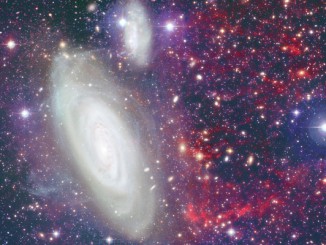
Astronomers have discovered a spectacular tail of gas more than 300,000 light-years across coming from a galaxy known as NGC 4569, 55 million light-years away in the Virgo Cluster. The plume is made up of hydrogen gas — the material new stars are made of — and is five times longer than the galaxy itself.

Picture This

A young star’s moment in the spotlight

A newly formed star lights up the surrounding cosmic clouds in this new image from ESO’s La Silla Observatory in Chile. Dust particles in the vast clouds that surround the young T-tauri star HD 97300 diffuse its light, like a car headlight in enveloping fog, and create the reflection nebula IC 2631.

Picture This

Exploring the riches of the Southern Cross

The Southern Cross, or Crux to give it its official name, is the smallest of all the 88 constellations and an iconic feature of the antipodean sky. Yet it is not solely an asterism and navigation aid of the far south, as it can be seen from the Tropic of Cancer when best placed. Come and explore its wealth of interesting objects for binoculars and small telescopes.

News

Hundreds of nearby galaxies found hidden behind the Milky Way

An international team of scientists used the 64-metre Parkes Radio Telescope equipped with an innovative receiver to see through the stars and dust of the Milky Way, into a previously unexplored region of space. Hundreds of hidden nearby galaxies have therefore been studied for the first time, shedding light on a mysterious gravitational anomaly dubbed the Great Attractor.

News

Earth-like exoplanets have Earth-like interiors

Every school child learns the basic structure of the Earth: a thin outer crust, a thick mantle, and a Mars-sized core. But is this structure universal? Will rocky exoplanets orbiting other stars have the same three layers? New research suggests that the answer is yes — they will have interiors very similar to Earth.