News

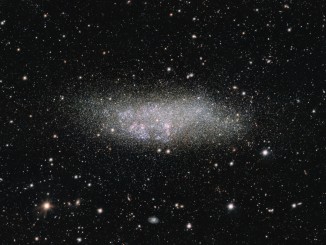
This image shows a lonely galaxy known as Wolf-Lundmark-Melotte, or WLM for short. Although considered part of our Local Group of dozens of galaxies, WLM stands alone at the group’s outer edges as one of its most remote members. In fact, WLM is so small and secluded that it may never have interacted with any other galaxy in the history of the universe.
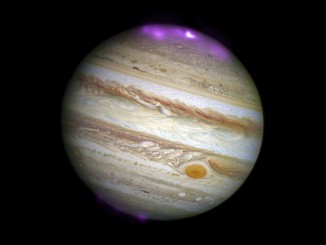
Solar storms are triggering X-ray aurorae on Jupiter that are about eight times brighter than normal over a large area of the planet and hundreds of times more energetic than Earth’s “northern lights,” according to a new study using data from NASA’s Chandra X-ray Observatory when a giant solar storm arrived at the planet.
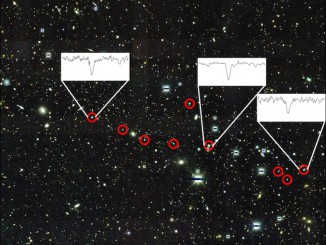
The lightest few chemical elements formed minutes after the Big Bang. Most heavier elements in the periodic table are created by stars, either from internal nuclear fusion or in catastrophic explosions. New observations of a dwarf galaxy discovered last year show that the heaviest elements, such as gold and lead, are likely left over from rare collisions between two neutron stars.
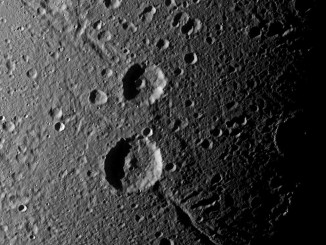
In this image from NASA’s Cassini spacecraft we see a crater duo on Saturn’s 698-mile-wide moon Dione. The upper of the pair, named Italus, is overprinted on a grouping of ancient troughs called Petelia Fossae. The lower crater, Caieta, sits atop a feature named Helorus Fossa. Fossae on Dione are believed to be tectonic features.
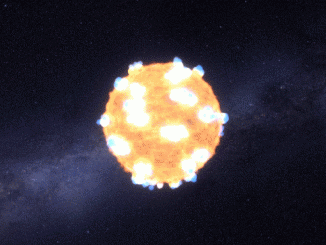
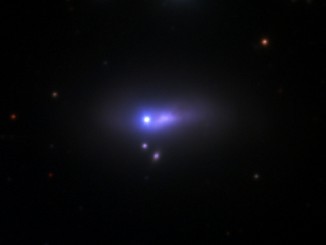
Astronomers have captured the earliest minutes of two exploding stars and for the first time seen a shockwave generated by a star’s collapsing core. The international team found a shockwave only in the smaller supernova — a finding that will help them understand these complex explosions that create many of the elements that make up the Earth and solar system.

Quasars are the discs of hot gas that form around supermassive black holes at the centre of massive galaxies — they are hotter than the surface of the Sun, generating enough light to be seen across the observable universe. New research has revealed quasar wind speeds of 20 percent the speed of light near a supermassive black hole.
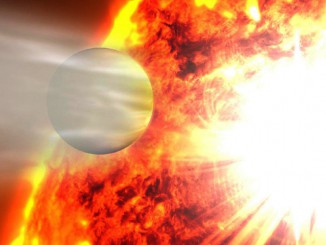
A team of researchers led by San Francisco State University astronomer Stephen Kane were able to detect a signal of reflected light from a planet known as HD 20782 b — a “flash” of starlight bouncing off the planet’s atmosphere as it made its closest orbital approach to its parent star on the most eccentric, comet-like orbit yet seen.
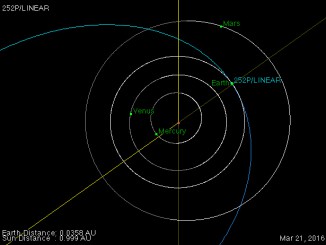
Comet 252P/LINEAR will zip past Earth on Monday, 21 March at a range of about 3.3 million miles. The following day, comet P/2016 BA14 will safely fly by our planet at a distance of about 2.2 million miles, or nine times the distance to the Moon. This will be the second closest flyby of a comet in recorded history next to comet D/1770 L1 (Lexell) in 1770.
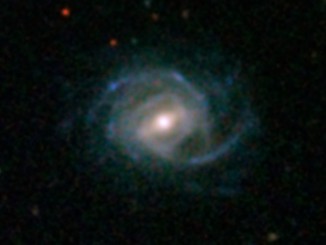
A strange new kind of galactic beast has been spotted in the cosmic wilderness. Dubbed “super spirals,” these unprecedented galaxies dwarf our own spiral galaxy, the Milky Way, and compete in size and brightness with the largest galaxies in the universe. The galaxies have long hidden in plain sight by mimicking the appearance of typical spirals.
© 2019 Pole Star Publications Limited