Picture This

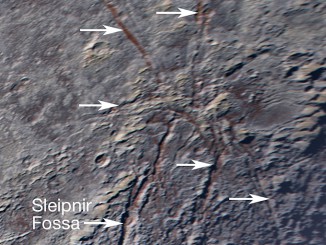
Pluto’s icy ‘spider’

Sprawling across Pluto’s icy landscape is an unusual geological feature that resembles a giant spider. This enhanced colour image, obtained by NASA’s New Horizons spacecraft on 14 July 2015, consists of at least six extensional fractures (arrowed) converging to a point near the centre. Curiously, the spider’s “legs” expose red deposits below Pluto’s surface.

News

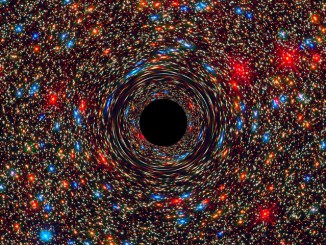
Supermassive black hole found in an unlikely place

A near-record 17-billion-solar-mass black hole discovered in a sparse area of the local universe indicates that these monster objects may be more common than once thought. The newly discovered supermassive black hole is in NGC 1600, an elliptical galaxy in the constellation Eridanus some 149 million light-years away.

News

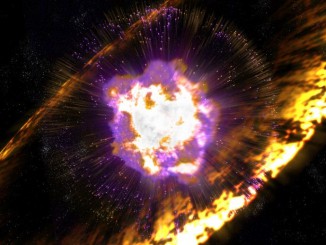
Supernovae showered Earth with radioactive iron

An international team of scientists has found radioactive iron-60 in sediment and crust samples taken from the Pacific, Atlantic and Indian Oceans. They report that a series of massive supernova explosions occurring between 3.2 and 1.7 million years ago from stars less than 300 light-years away showered the Earth with radioactive debris.

News

Early Mars bombardment likely enhanced its habitability

Much of the action on Mars occurred during a period known as the Late Heavy Bombardment about 3.9 billion years ago. Large comets and asteroids raining down on the planet would have produced enough heat to melt subsurface ice, likely enhancing climate conditions enough to make Mars more conducive to life — at least for a time.

Picture This

Hubble reveals a cosmic trick of the eye

While truly massive stars go out in a blaze of glory, intermediate-mass stars — those between roughly one and eight times the mass of the Sun — are somewhat quieter. Such stars eventually form cosmic objects known as planetary nebulae, so named because of their vague resemblance to planets when seen through early, low-resolution telescopes.

News

The ‘topsy turvy’ ocean circulation of saline exoplanets

According to new research, the salt levels of oceans on distant Earth-like planets could have a major effect on their climates. Computer models reveal that exoplanets with very saline oceans could have circulation patterns opposite to that on Earth, resulting in dramatic warming of their polar regions, possibly extending their range of habitability.