Picture This

Hubble spies the archetypal barred spiral galaxy

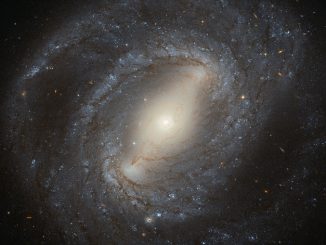
Discovered in 1784 by William Herschel, NGC 4394 is the archetypal barred spiral galaxy, with bright spiral arms emerging from the ends of a bar that cuts through the galaxy’s central bulge. Some 55 million light-years from Earth, the galaxy lies in the constellation of Coma Berenices. NGC 4394 is considered to be a member of the Virgo Cluster.
News

Rare transit of Mercury to take place on 9 May

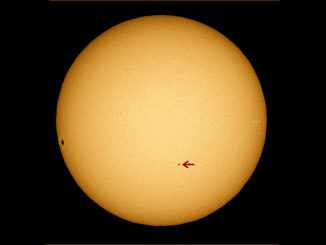
On Monday, 9 May there will be a rare transit of Mercury, when the innermost planet in our solar system will pass directly between the Earth and the Sun. The last time this happened was in 2006. With a properly filtered telescope and fine weather, the entire 7½-hour event can be seen from the British Isles.

Picture This

New Ceres images show bright craters

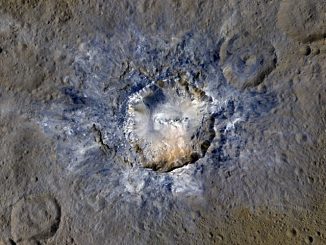
Craters with bright material on dwarf planet Ceres shine in new images from NASA’s Dawn mission taken from its lowest-altitude mapping orbit. Young crater Haulani (diameter 21 miles) and 6-mile-wide Oxo Crater — the second-brightest feature on Ceres — provide scientists with insight into the dwarf planet’s materials and surface morphology.

News

Chandra sees comets in the “X”-treme

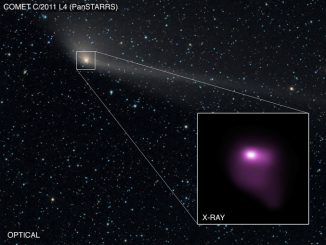
Scientists have determined that comets produce X-ray emission when particles in the solar wind strike the comet’s atmosphere. Recently, astronomers announced the results of a study using data collected with NASA’s Chandra X-ray Observatory of two comets — C/2012 S1 ISON and C/2011 S4 PanSTARRS — when both were relatively close to Earth.

Picture This

Lenticular galaxy conceals an eventful past

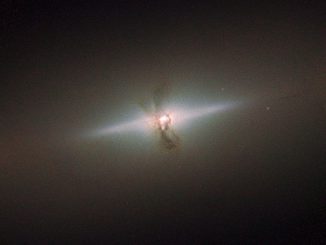
The elegant simplicity of NGC 4111, seen here in this image from the NASA/ESA Hubble Space Telescope, hides a more violent history than you might think. NGC 4111 is a lenticular, or lens-shaped, galaxy, lying about 50 million light-years from us in the constellation of Canes Venatici (The Hunting Dogs).

News

Pluto’s atmospheric haze varies in brightness

Scientists on NASA’s New Horizons mission team are learning more about the structure and behaviour of Pluto’s complex atmosphere by discovering new attributes of its extensive haze layers. The hazes were first discovered by New Horizons in July 2015, as the spacecraft swept past Pluto and made its historic first exploration of the mysterious dwarf planet.

News

Kepler spacecraft remains stable as health check continues

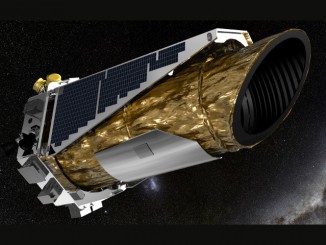
NASA’s Kepler planet-hunter spacecraft remains stable as the process of returning it to science continues. The cause of the anomaly, first reported on 8 April, remains under investigation. Charlie Sobeck​, Kepler and K2 mission manager at NASA’s Ames Research Center, explains the steps taken by mission operations engineers to resume the K2 mission.