News

Discovery measures “heartbeats” of a distant galaxy’s stars

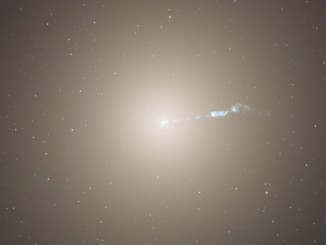
In many ways stars are like living beings. They’re born; they live; they die. And they even have a heartbeat. Near the end of their lifetime they begin to pulsate, increasing and decreasing their brightness by a large amount every few hundred days. Using a novel technique, astronomers have detected thousands of stellar “pulses” in the galaxy Messier 87 (M87). Their measurements offer a new way of determining a galaxy’s age.

News

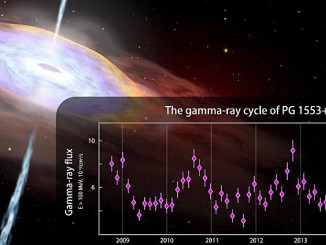
NASA’s Fermi finds hints of gamma-ray cycle in active galaxy

Astronomers using data from NASA’s Fermi Gamma-ray Space Telescope have detected hints of periodic changes in the brightness of a so-called “active” galaxy, whose emissions are powered by a supersized black hole. If confirmed, the discovery would mark the first years-long cyclic gamma-ray emission ever detected from any galaxy, which could provide new insights into physical processes near the black hole.

Picture This

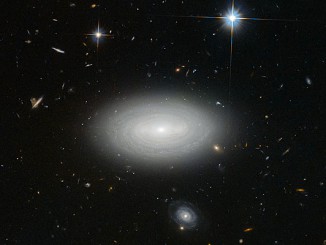
Hubble views a lonely galaxy

Only three local stars appear in this image, quartered by right-angled diffraction spikes. Everything besides them is a galaxy; floating like a swarm of microbes in a drop of water, and brought into view here not by a microscope, but by the Advanced Camera for Surveys on the Hubble Space Telescope.

News

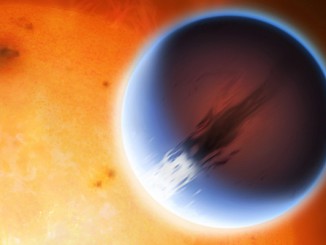
5,400mph winds hurtling around exoplanet

Wind speeds of over 2 kilometres per second have been discovered flowing around planet outside of our solar system. The University of Warwick discovery is the first time that a weather system on an exoplanet has been directly measured and mapped. The wind speed recorded is 20x greater than the fastest ever known on Earth, where it would be seven times the speed of sound.

Picture This

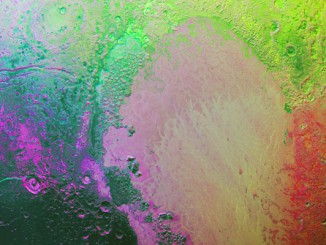
Psychedelic Pluto

NASA’s New Horizons scientists made this false colour image of Pluto using a technique called principal component analysis to highlight the many subtle colour differences between Pluto’s distinct regions. The image data were collected by the spacecraft’s Ralph/MVIC colour camera on 14 July at 11:11 UTC, from a range of 22,000 miles (35,000 kilometres).

News

Oldest stars ever seen found near Milky Way centre

Astronomers have discovered the oldest stars ever seen, dating from before the Milky Way Galaxy formed, when the universe was just 300 million years old. The stars, found near the centre of the Milky Way, are surprisingly pure but contain material from an even earlier star, which died in an enormous explosion called a hypernova.

News

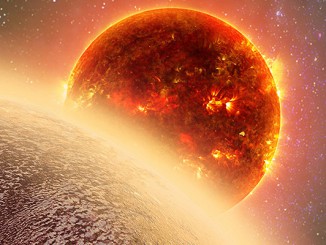
Earth-sized rocky planet found orbiting a nearby star

The collection of rocky planets orbiting distant stars has just grown by one, and the latest discovery is the most intriguing yet. Known as GJ 1132b, the newfound world lies just 39 light-years away. Although hot as an oven, the 9,200 mile-wide planet is cool enough to potentially host an atmosphere. If it does, we could study that atmosphere in detail with the Hubble Space Telescope and future observatories like the Giant Magellan Telescope.