Picture This

What’s eating at Pluto?

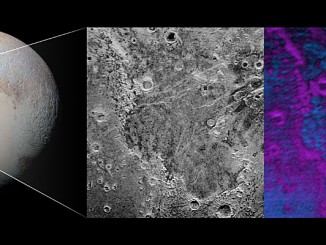
Far in the dwarf planet’s western hemisphere, scientists on NASA’s New Horizons mission have discovered what looks like a giant “bite mark” on Pluto’s surface. They suspect that the methane ice-rich surface on Pluto may be sublimating away into the atmosphere, exposing a layer of water-ice underneath.
News

Clocking the rotation rate of a supermassive black hole

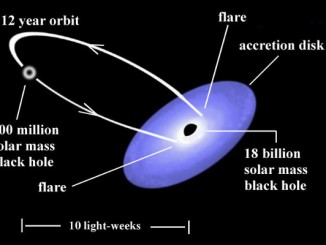
A recent observational campaign involving more than two dozen optical telescopes and NASA’s space-based SWIFT X-ray telescope allowed a team of astronomers to measure very accurately the rotational rate of one of the most massive black holes in the universe. The black hole powers a quasar called OJ 287 which lies about 3.5 billion light-years away from Earth.

Picture This

The Saturnian sisters

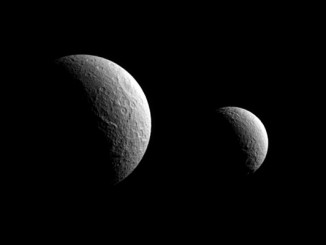
Similar in many ways, Saturn’s moons Tethys and Rhea (left and right, respectively) even share a discoverer: Giovanni Cassini, namesake of the NASA spacecraft that captured this view. Although somewhat different in size, Rhea (949 miles across) and Tethys (660 miles) are both composed largely of ices and are generally thought to be geologically inactive today.

News

Close comet flyby threw Mars’ magnetic field into chaos

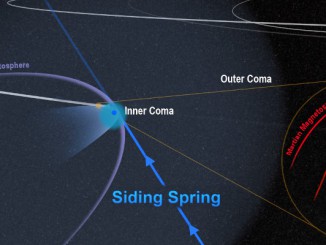
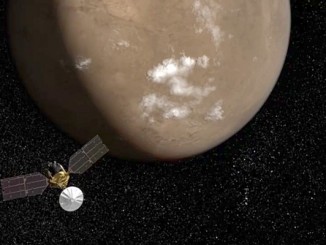
The close encounter between comet Siding Spring and Mars in October 2014 flooded the planet with an invisible tide of charged particles from the comet’s coma, according to data from NASA’s Mars Atmosphere and Volatile Evolution (MAVEN) spacecraft. The comet’s powerful magnetic field temporarily merged with, and overwhelmed, the planet’s weak field.

News

Dark matter satellites trigger massive birth of stars

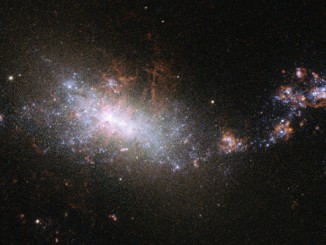
Astronomers have used computer simulations based on theoretical models to explain massive star formation observed in dwarf galaxies. Researchers in the US and the Netherlands found that during a dark matter satellite’s closest approach to a dwarf galaxy, through gravity it compresses the gas in the dwarf, triggering significant episodes of starbursts.

News

VLTI’s sharpest view ever of dusty disc around ageing star

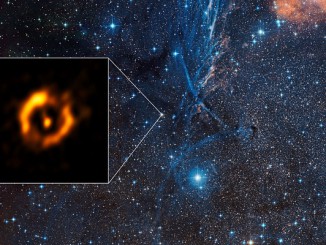
The Very Large Telescope Interferometer at ESO’s Paranal Observatory in Chile has obtained the sharpest view ever of the dusty disc around an ageing star. For the first time such features can be compared to those around young stars — and they look surprisingly similar. It is even possible that a disc appearing at the end of a star’s life might also create a second generation of planets.

Eclipse

Highlights of 9 March total solar eclipse from Micronesia

Although thick cloud in parts of Indonesia spoiled the view for some along the path of totality, tens of millions more were greeted to spectacular views of the 9 March total solar eclipse. NASA, in partnership with the Exploratorium Science Center, hosted live coverage of the event from the coral island of Woleai in the Pacific Ocean.

Eclipse

Watch the 9 March total solar eclipse live

If you left it too late to book your Indonesian flight to view the total solar eclipse on the morning of Wednesday, 9 March (UT), don’t despair — put away your passport, sit back and enjoy the spectacle online, courtesy of Exploratorium and NASA TV. For virtual eclipse viewers in the UK, the event starts at 1am GMT on 9 March.