
News



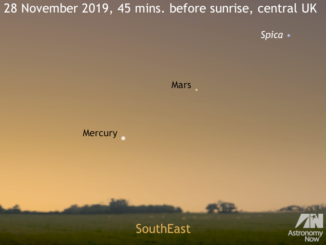
Innermost planet Mercury puts on its best morning display of the year for Northern Hemisphere observers from late November to early December. Skywatchers in the British Isles should find a location offering an unobstructed view of the southeast horizon about 45 minutes before sunrise to get the best views, with the Red Planet and star Spica – the brightest in Virgo – also nearby.

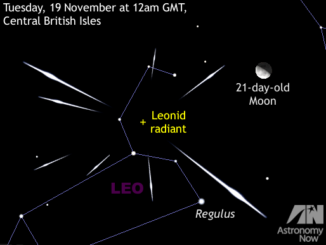
The maximum of the annual Leonid meteor shower is predicted for 11pm GMT (23h UT) on Monday, 18 November 2019. However, the famously swift, bright Leonids — some leaving persistent trails — will have to contend with the glare of a 21-day-old waning gibbous Moon close by visible from 9:30pm GMT to dawn on the 19th.
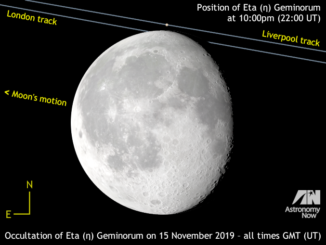
Lucky observers with clear skies who also happen to live on a line drawn between Porthcawl on the Welsh coast through just south of Birmingham and on to the Lincolnshire Wolds can witness a grazing lunar occultation of naked-eye star Eta (η) Geminorum by the rising 18-day-old waning gibbous Moon just before 10pm GMT on 15 November 2019.
© 2026 Nebula Press Ltd