Picture This

Smoke ring for a halo

Two stars shine through the centre of a ring of cascading dust in this image taken by the NASA/ESA Hubble Space Telescope. The star system is named DI Chamaeleontis, or DI Cha, in the far southern constellation of the Chameleon. While only two stars are apparent, it is actually a quadruple system containing two sets of binary stars.

Equipment

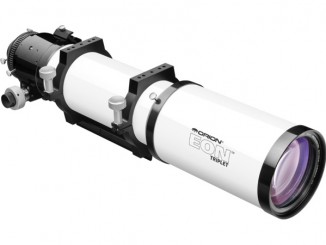
Orion EON 115mm ED triplet APO refractor

ED glasses are fast becoming ubiquitous in astronomical equipment, particularly in banishing the remnants of chromatic aberration of the classic refractor. Steve Ringwood takes a look at a 115mm (4.5″) f/7 air-spaced triplet from Orion in the USA. Designed for both visual use and astrophotography, it sports a beefy three-inch dual-speed Crayford focuser and comes supplied its own hard carry case.

News

Finding new worlds with a play of light and shadow

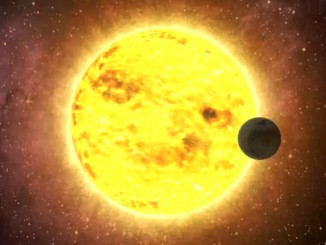
One method to discover planets beyond the solar system by far is transit photometry, which measures changes in a star’s brightness when a planet crosses in front of its star along our line of sight. NASA’s Kepler Space Telescope has used this technique to become the most successful planet-hunting spacecraft to date, with more than a thousand established discoveries. Satellites carrying improved technology for all-sky surveys are now planned, missions that will tell us a great deal about alien planetary systems similar to our own.

News

Skull-shaped Halloween close fly-by object is likely a dead comet

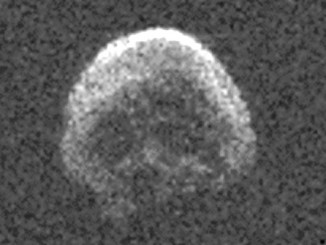
Somewhat appropriately spooky for Halloween in recent radar images, 600 metre-wide near-Earth object 2015 TB145 dashes by our planet today. Now believed to be a dead comet that has shed its volatiles after numerous passes around the Sun, the object makes its closest approach to Earth at 5pm GMT. UK observers with clear skies may see it with modest telescopes in the early evening.

Picture This

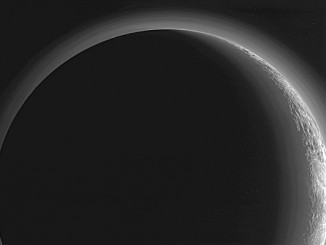
New Horizons returns full view of Pluto’s stunning crescent

In September, the New Horizons team released a stunning but incomplete image of Pluto’s crescent. Thanks to updated processing work by the science team, New Horizons is releasing the entire, breathtaking image of Pluto. The team also released images showing extended mapping of the dwarf planet’s “heart” feature and young craters on Pluto’s largest moon, Charon.

News

Q Continuum computer simulation models birth of universe

Researchers are sifting through an avalanche of data produced by one of the largest cosmological simulations ever performed. The simulation, run on the Titan supercomputer at the U.S. Department of Energy’s Oak Ridge National Laboratory, modelled the evolution of the universe from just 50 million years after the Big Bang to the present day.

Observing

See the Moon score a Bull’s-Eye in Taurus on 29 October

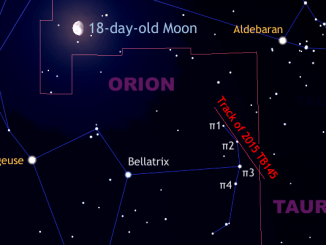
On Thursday, 29 October, observers in the British Isles with clear skies and armed with binoculars or small telescopes can see the waning gibbous 17-day-old Moon occult first-magnitude star Aldebaran, the ‘Eye of the Bull’ in the constellation Taurus. The star slips behind the Moon soon after 9:45pm GMT and reappears at the darkened lunar hemisphere about an hour later.

News

Surprising discovery of molecular oxygen on comet 67P

ESA’s Rosetta spacecraft has made the first in situ detection of oxygen molecules outgassing from Comet 67P/Churyumov-Gerasimenko, a surprising observation that suggests they were incorporated into the comet during its formation. This may have implications for our understanding of the chemistry involved in the formation of the solar system some 4.6 billion years ago.