News

The ‘topsy turvy’ ocean circulation of saline exoplanets

According to new research, the salt levels of oceans on distant Earth-like planets could have a major effect on their climates. Computer models reveal that exoplanets with very saline oceans could have circulation patterns opposite to that on Earth, resulting in dramatic warming of their polar regions, possibly extending their range of habitability.
Observing

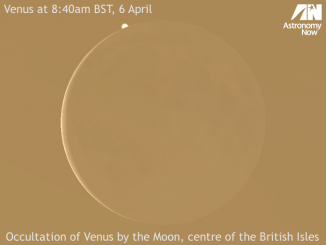
The Moon hides Venus in the morning sky

On the morning of Wednesday, 6 April experienced observers in the British Isles with a clear sky living south of a line drawn between Galway in Ireland, Dumfries in Scotland and Berwick-upon-Tweed in Northumberland can potentially observe planet Venus slip behind the northern polar regions of the 28-day-old waning crescent Moon. But beware: the Sun lies just 16 degrees away.

Picture This

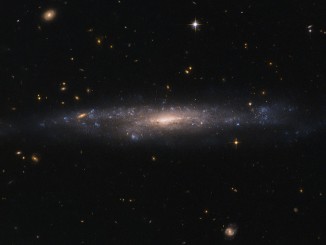
Hubble captures a low surface brightness galaxy

This striking NASA/ESA Hubble Space Telescope image depicts the low surface brightness (LSB) galaxy known as UGC 477, located just over 110 million light-years away in the constellation of Pisces. LSB galaxies appear to be dominated by dark matter, making them excellent objects to study to further our understanding of this elusive substance.

News

Astronomers discover white dwarf with an oxygen atmosphere

Researchers have discovered a white dwarf star with an atmosphere dominated by oxygen — a type of white dwarf that has been theorised to exist but not identified to date. The finding could challenge the textbook wisdom of single stellar evolution, and provide a critical link to some types of supernovae discovered over the past decade.

Equipment

Baader 2″ Diamond SteelTrack focusers

Steve Ringwood reviews a new range of precision focusers aimed at refractors, SCTs and Newtonians that employ real diamonds to create a micro-geared high-precision drive system. Capable of handling a load of 6kg (13 lbs), these focusers offer complete freedom from backlash and flexure. Motor drive option with focus control via PC also available.

Picture This

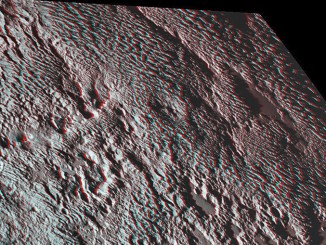
View Pluto’s bladed terrain in 3-D

One of the strangest landforms spotted by NASA’s New Horizons spacecraft when it flew past Pluto was the “bladed” terrain formally named Tartarus Dorsa. The blades reach hundreds of feet high and are typically spaced a few miles apart. No geology degree is necessary to see why the terrain is so interesting — just grab your red and green 3-D spectacles.

News

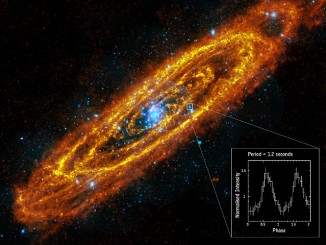
Andromeda Galaxy’s first spinning neutron star found

Decades of searching in the Andromeda Galaxy has finally paid off, with the discovery of an elusive breed of stellar corpse — a neutron star, by ESA’s XMM-Newton space telescope. Neutron stars are the small and extraordinarily dense remains of a once-massive star that exploded as a powerful supernova at the end of its natural life.

News

Global Astronomy Month begins 1 April

Global Astronomy Month (GAM), organised each April by Astronomers Without Borders, is the world’s largest annual global celebration of astronomy. Each GAM brings new ideas and new opportunities, and GAM 2016 is no exception, once again bringing enthusiasts together worldwide to celebrate Astronomers Without Borders’ motto: One People, One Sky.