Picture This

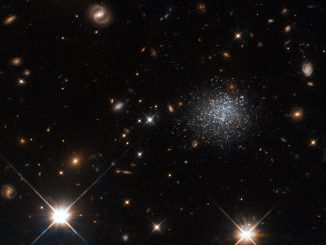
Hubble views a stubborn dwarf galaxy

The fuzzy collection of stars seen in this NASA/ESA Hubble Space Telescope image forms an intriguing dwarf galaxy named LEDA 677373, located about 14 million light-years away from us in the constellation Centaurus. This particular dwarf galaxy contains a plentiful reservoir of gas from which it could form stars, but it stubbornly refuses to do so. Why?

Observing

See Mars before it gets too distant, lost in the dusk twilight

Mars lies highest in the sky to the south soon after sunset at the beginning of July for observers in the UK, so you should not waste any opportunities to view the Red Planet while it is close and still relatively large in size. Tharsis, the great Martian volcanic plateau that is home to the largest volcanoes in the solar system, is turned toward Earth in the first week of the month.

News

Chaotic orbit of Comet Halley explained

Halley’s Comet, officially designated 1P/Halley, is visible from Earth every 75–76 years. Despite this regular return, the comet’s orbit cannot be predicted exactly due to processes inside the comet and its chaotic interaction with the planets and minor bodies in the solar system. A team of Dutch and Scottish researchers has now found an explanation for the chaotic orbital behaviour of 1P/Halley.

Picture This

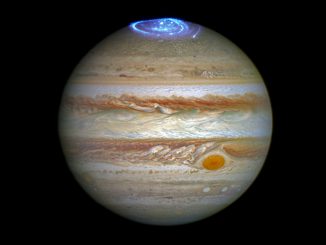
Hubble captures vivid aurorae in Jupiter’s atmosphere

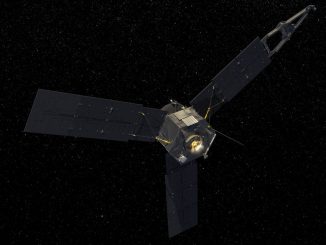
Astronomers are using the NASA/ESA Hubble Space Telescope to study aurorae — stunning light shows in a planet’s atmosphere — on the poles of the largest planet in the solar system, Jupiter. This observation program is supported by measurements made by NASA’s Juno spacecraft, shortly to arrive at the gas giant.

News

A 6,000-year-old telescope without a lens

Astronomers are exploring what might be described as the first astronomical observing tool, potentially used by prehistoric humans 6,000 years ago. They suggest that the long, narrow entrance passages to ancient stone tombs may have enhanced their view of the night sky, enabling them to detect the first appearance of seasonal stars during twilight.