News

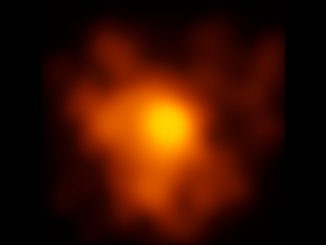
An international team of astronomers have used the Very Large Telescope Interferometer to image the Eta Carinae star system in the greatest detail ever achieved. They found new and unexpected structures within the binary system, including in the area between the two stars where extremely high velocity stellar winds are colliding.
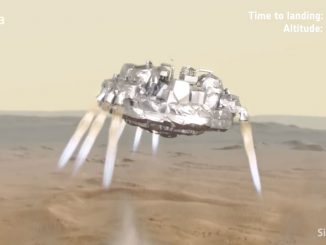
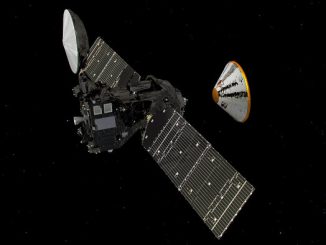
Live coverage of the ExoMars Trace Gas Orbiter and the Schiaparelli lander arriving at Mars. Text updates will appear automatically below; there is no need to reload the page. Follow us on Twitter.
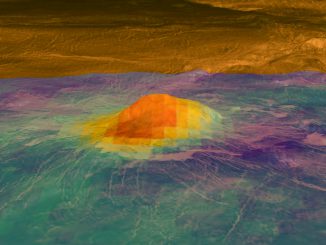
Planetary researchers at the German Aerospace Center (DLR) have pushed the limits of the data resolution from ESA’s Venus Express spacecraft. With this new technique, analysis of the top and eastern flank of 200-kilometre-wide volcano Idunn Mons in the southern hemisphere of Venus revealed an indication of geologically recent volcanism in this area.
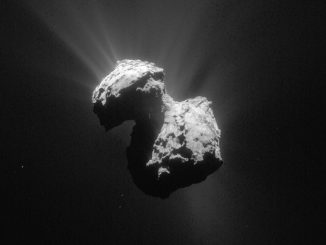
Canadian researchers have charted a path that most likely pinpoints the very origins of 67P/Churyumov-Gerasimenko, the comet studied intensively by ESA’s Rosetta spacecraft. Western University astronomers believe that 67P is made from primordial material and relatively new to the inner parts of our solar system, having only arrived about 10,000 years ago.
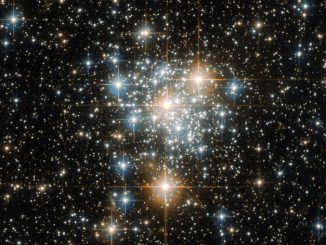
It may be famous for hosting the Small Magellanic Cloud (SMC) and 47 Tucanae, the second brightest globular cluster in the night sky, but the southern constellation of Tucana (The Toucan) also possesses a variety of unsung cosmic beauties. One such beauty is NGC 299, an open star cluster located within the SMC just under 200,000 light-years away.
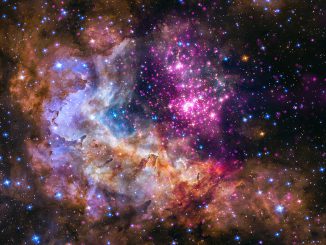
Each year, NASA’s Chandra X-ray Observatory helps celebrate American Archive Month by releasing a collection of images using X-ray data. Each of these six new images — representing just a small fraction of the treasures that reside in Chandra’s unique archive — also includes data from telescopes covering other parts of the electromagnetic spectrum, such as visible and infrared light.
© 2019 Pole Star Publications Limited