News

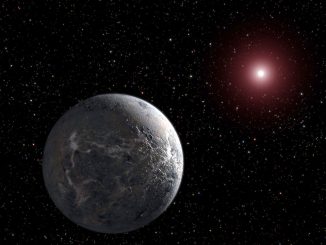
A group of researchers has observed the first ground-based transit observation of K2-3d — a potentially Earth-like extrasolar planet supposedly within the habitable zone around a bright M-dwarf host star 147 light-years away — using the multi-band imager MuSCAT on the Okayama Astrophysical Observatory’s 1.88-metre telescope.
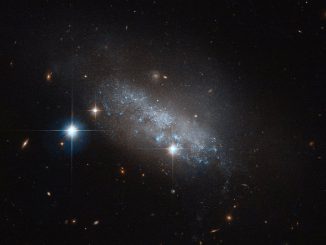
This NASA/ESA Hubble Space Telescope image reveals a delicate blue group of stars — actually an irregular galaxy named IC 3583 — that sits some 30 million light-years away in the constellation of Virgo. This small galaxy is thought to be gravitationally interacting with one of its neighbours, the spiral Messier 90.
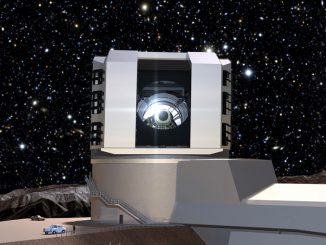


Find a location that offers you an unobstructed view of the horizon from south to southwest an hour after sunset. With clear skies, you’ll be able to follow Venus and Mars from night to night on their celestial peregrinations through the constellations of Sagittarius and Capricornus. The two planets almost keep pace with each other throughout the remainder of November.
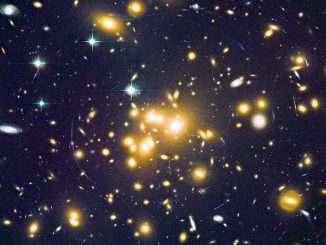
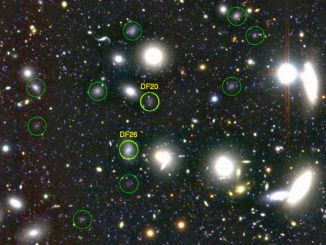
Researchers have found a large population of distant dwarf galaxies that could reveal important details about a productive period of star formation in the universe billions of years ago. It is believed that dwarf galaxies played a significant role during the so-called reionisation era in transforming the dark early universe into one that is bright, ionised and transparent.
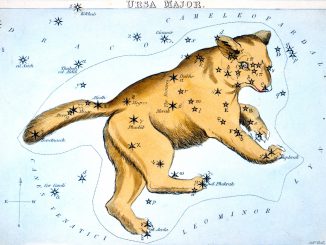
The creation of a specialised IAU Working Group, the Working Group on Star Names (WGSN), was approved by the IAU Executive Committee in May 2016 to formalise star names that have been used colloquially for centuries. WGSN has now established a new catalogue of IAU star names, with the first set of 227 approved names published on the IAU website.
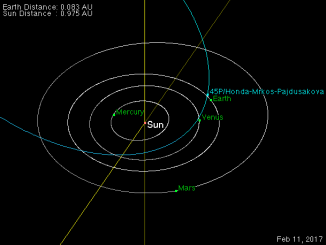
Amateur and professional astronomers are invited to provide observations of comets 41P/Tuttle-Giacobini-Kresák, 45P/Honda-Mrkos-Pajdušáková, and 46P/Wirtanen that will pass by Earth at distances ranging from 0.08 to 0.15 astronomical units. Such close approaches of a trio of comets within the next two years are rare and typically occur only once every few decades.
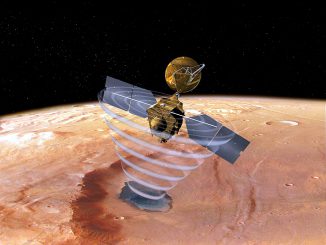
Researchers using NASA’s Mars Reconnaissance Orbiter have determined that frozen beneath a region of cracked and pitted plains on the Red Planet there lies about as much water as fills Lake Superior, largest of the Great Lakes. Scientists examined part of Mars’ Utopia Planitia region with the orbiter’s ground-penetrating instrument, revealing a deposit more extensive in area than the state of New Mexico.
© 2019 Pole Star Publications Limited