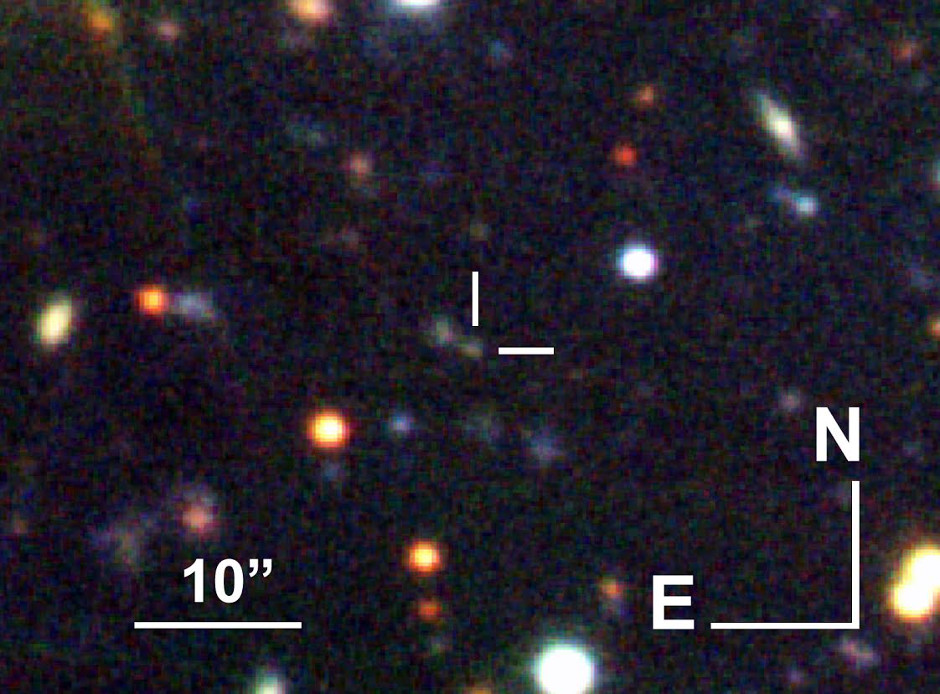
An optical image of the sky at the location of a faint galaxy (marked with the cross-hairs) where gamma-ray burst GRB 140606B was seen last year. Follow-up studies of the burst and its afterglow find that it originated in a supernova — the death of a massive star — yet also shows signs of shocks more typically originating in GRBs from merging binary stars. Image credit: Cano et al.Gamma ray bursts (GRBs) — flashes of high-energy light occur about once a day, randomly, from around the sky — are the brightest events in the known universe. While a burst is underway, it is many millions of times brighter than an entire galaxy. Astronomers are anxious to decipher their nature not only because of their dramatic energetics, but also because their tremendous brightness enables them to be seen across cosmological distances and times, providing windows into the young universe.
There appear to be two general types of GRBs: those associated with the deaths of massive stars, and ones believed to originate from the coalescence of two extreme objects (neutron stars or black holes) that had been orbiting each other in a binary system. In general the two types can be distinguished by the lengths of their bursts, the former lasting longer than a few seconds, while the latter are briefer.
Astronomers think that, despite the differences, both kinds of GRBs have hot discs accreting material leading to the production of bipolar jets of charged particles moving at relativistic speeds. In the standard model, shocks internal to the fireball produce the gamma-rays in the first (longer duration) case, while shocks from the jets’ interactions with the external medium produce the initial burst of gamma-rays in the second case. Many details are similar in both scenarios, however, while some others vary according to the type, and astronomers have been trying to constrain these various parameters so that they can trace the origin of each GRB more precisely.This is an artist’s impression of GRB 080319B, a gamma-ray burst detected by the Swift satellite at 06:12 UTC on 19 March 2008 in the constellation Boötes. The burst set a new record for the farthest object that was observable with the naked eye as it had a peak magnitude of +5.8 for around 30 seconds. Observations reveal that the jets of the gamma-ray burst were aimed almost directly at the Earth. GRB 080319B’s redshift was measured at 0.937, which implies a distance of 7.5 billion light-years. Image credit: ESO.CfA astronomer Raffaella Margutti and her colleagues used several ground-based telescopes to follow-up GRB 140606B that went off in June 2014, examining the afterglow from about three days after the detection to about one hundred and twenty days later. They conclude that the burst is associated with a massive star’s death (a supernova), but find that some of its emission apparently results from shocks external to the fireball as are seen in the less luminous class of GRBs. The results are consistent with the predictions of supernova modelling, but the fact that this object spans both classes highlights the complexity of the sometimes-overlapping physical processes at work and the importance of observations at multiple wavelengths.
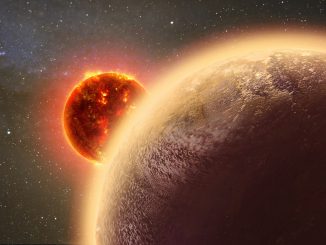
The distant planet GJ 1132b intrigued astronomers when it was discovered last year. Located just 39 light-years from Earth and orbiting its red dwarf star every 1.6 days, new research shows that despite being baked to a temperature of around 232 °C, GJ 1132b might possess a thin, oxygen atmosphere — but no life due to its extreme heat.
The Phoenix cluster is an enormous accumulation of about 1,000 galaxies, located 5.7 billion light years from Earth. At its center lies a massive galaxy, which appears to be spitting out stars at a rate of about 1,000 per year.
Astronomers using an orbiting radio telescope in conjunction with four ground-based radio telescopes have achieved the highest resolution, or ability to discern fine detail, of any astronomical observation ever made. The researchers were surprised when their Earth-space system revealed a core temperature hotter than 10 trillion degrees for quasar 3C 273.