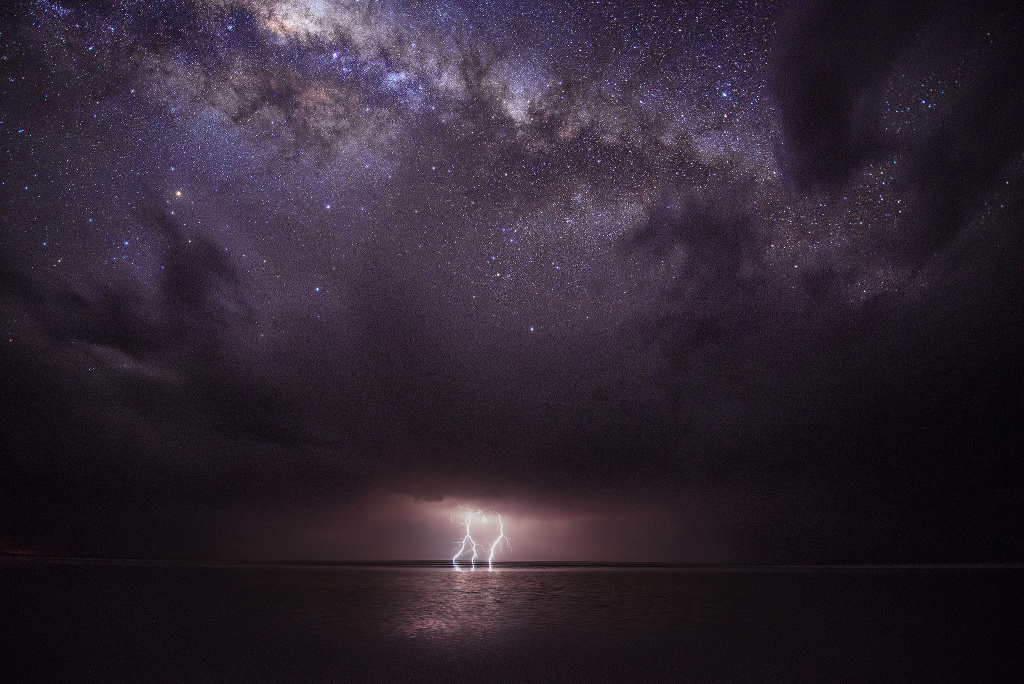
Over the coming weeks we will feature, in no particular order, each of the final 16 selected images and winners will be announced by Royal Museums Greenwich on 17 September. The winning images are to be showcased at the Royal Observatory Greenwich in an exhibition opening 18 September.
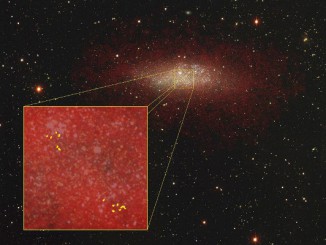
Nearby dwarf galaxy Wolf—Lundmark—Melotte (WLM) poses an intriguing mystery: How is it able to form brilliant star clusters without the dusty, gas-rich environments found in larger galaxies? The answer, astronomers believe, lies in densely packed and previously unrecognised nuggets of star-forming material sprinkled throughout the galaxy.
A European team of astronomers have used the new GRAVITY instrument at ESO’s Very Large Telescope to obtain exciting observations of the centre of the Milky Way by combining light from all four of the 8.2-metre Unit Telescopes for the first time. These results provide a taste of the groundbreaking science that GRAVITY will produce as it tests Einstein’s general relativity.
The Local Group of galaxies has just grown in number with the Hubble Space Telescope discovery of KKs 3 — a dwarf spheroidal some 7 million light-years away in the far southern constellation of Hydrus.