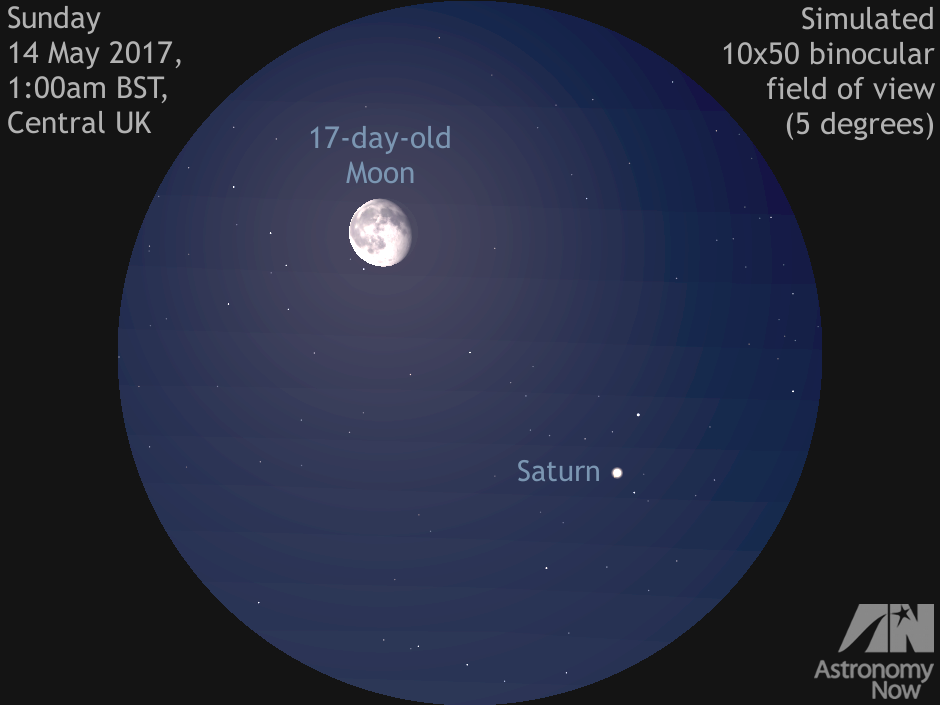
In the small UK hours of Sunday 14 May, the rising 17-day-old Moon in the southeast lies just 2.4 degrees to the upper-left of ringed planet Saturn, meaning that the pair will fit comfortably in the same field of view of a typical 10×50 binocular. However, to see Saturn’s rings clearly you will need a telescope and a magnification of at least 50×. AN graphic by Ade Ashford.Saturn is the one planet guaranteed to elicit a ‘wow’ from a novice stargazer when seen through a telescope for the first time. And whatever size telescope you use, the sense of wonder at seeing the planet’s beautifully proportioned and symmetrical rings never grows old — especially now that the ring system is tilted at a very favourable angle to our line of sight. In case you’re wondering where to find the ringed planet, it’s the magnitude +0.2 ‘star’ visible low in the southeast at local midnight for observers in the British Isles.
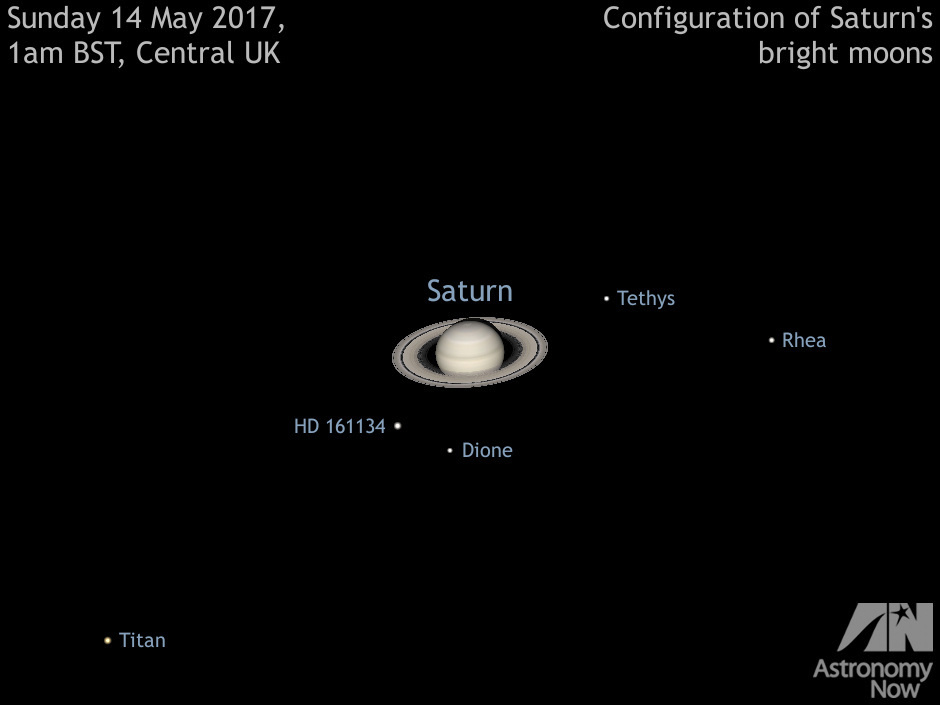
If you need a bit of a celestial pointer to Saturn and don’t mind staying up late on Saturday 13 May into the following morning, the 17-day-old waning gibbous Moon lies just 2½ degrees — roughly half the field of view of a typical 10×50 binocular — to the upper left of the ringed planet at 1am Sunday morning. This celestial pairing occurs in the constellation of Sagittarius, bordering on Ophiuchus.This computer simulation depicts the aspect of Saturn, its rings and brightest moons presented to Earth in the early UK hours of Sunday 14 May. This is an erect-image (north up, east left) view showing that the planet’s northern hemisphere is tipped towards Earth by an angle of just over 26 degrees. Largest Saturnian moon Titan (magnitude +9) and Rhea (magnitude +10.2) are the easiest to see in small telescopes, followed by Tethys (magnitude +10.8) and Dione (magnitude +11). Don’t confuse Dione with magnitude +8.5 background star HD 161134. Users of reflectors (Newtonian/Dobsonian) in the Northern Hemisphere need to rotate this image by 180 degrees to match the eyepiece view. Users of refractors, Maksutov- and Schmidt-Cassegrains with a star diagonal in place need to mirror the image left-right. AN graphic by Ade Ashford.We have a month to go until Saturn’s at its best this year at opposition, when the planet is also closest to Earth, which occurs on 15 June. Sadly, however, this is not the best of oppositions for UK observers since the planet attains an altitude of just 14 degrees (barely two-thirds of the span of an outstretched hand at arm’s length) above the southern horizon for the centre of the British Isles. Southern Hemisphere observers are currently enjoying the ringed planet very high in the sky.
As you gaze at Saturn, spare a thought for the enormously successful NASA/ESA/ISA Cassini spacecraft that is currently in the Grand Finale phase of what will be a 13-year-long mission at the planet, repeatedly diving between the rings and the globe, gathering data and images, until its firey high-speed demise in the cloudtops of Saturn in mid-September this year.
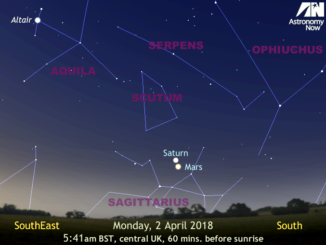
Early risers will already be aware that there’s currently a lot of planetary activity in the morning sky, but at dawn in Western Europe on Monday, 2 April, Mars and Saturn will be just 1¼ degrees apart and seen in the same field of view of telescopes at 30x magnification. The waning Moon is close by on the mornings of 7 & 8 April too.
Some of the most spectacular observing events tale place when the Moon’s around, most gloriously when it lines us perfectly over the Sun, producing a total eclipse of the Sun.