
17 September 2026
Astronomy Now
  • Home
  • The Magazine
    • About
    • Current Issue
    • Subscribe
    • Renew Subscription
  • AstroFest 2026
  • News
  • Observing
    • UK Sky Chart
    • Almanac
    • Scope Calc
    • DSLR Calc
  • Reviews
    • Equipment
    • Book Reviews
  • Spaceflight Now
  • Shop
  • Contact Us
    • Subscriptions
    • Your Views
    • Ask Astronomy Now
    • Editorial
    • Advertising
    • AstroListings
Latest News
  • [ 8 September 2026 ] 3I/ATLAS was born in the deep freeze News
  • [ 30 August 2026 ] Roman Space Telescope launches on mission to survey the Universe News
  • [ 24 August 2026 ] JWST’s ‘impossible’ early galaxies may be even more massive than we thought News
  • [ 7 August 2026 ] How to observe the 12 August 2026 solar eclipse Eclipse
  • [ 5 August 2026 ] Falcon 9 lunar impact: More than a new crater News
  • Facebook
  • Twitter
  • LinkedIn

Juno Post-Arrival News Conference

5 July 2016 Astronomy Now

Juno programme officials hold a news conference at NASA’s Jet Propulsion Laboratory following the successful orbital insertion of the space probe around the gas giant Jupiter.
  • JPL
  • Juno
  • Jupiter
  • NASA
  • NASA's Juno mission
  • NASA's Juno spacecraft

Related Articles

Observing

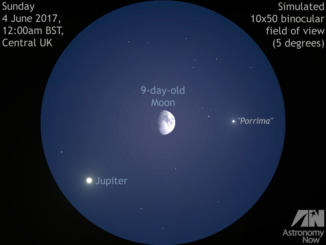
See the Moon hide double star Porrima then get close to Jupiter on 3—4 June

2 June 2017 Ade Ashford

Jupiter now lies highest in the UK sky at sunset, but the Solar System’s largest planet and its four bright Galilean moons still provide plenty of observable events during June, as we reveal. If you’re uncertain which evening ‘star’ is Jupiter, the Moon conveniently passes by on the night of 3—4 June, a time when European skywatchers can also see the Moon occult (hide) bright double star Porrima.
News

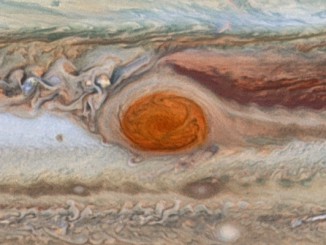
Hubble portrait captures changes in Jupiter’s Great Red Spot

13 October 2015 Astronomy Now

Scientists using the NASA/ESA Hubble Space Telescope have produced new maps of Jupiter that show the continuing changes in its famous Great Red Spot. The images also reveal a rare wave structure in the planet’s atmosphere that has not been seen for decades. This is the first in a series of annual portraits of the solar system’s outer planets which will help researchers study how they change over time.
News

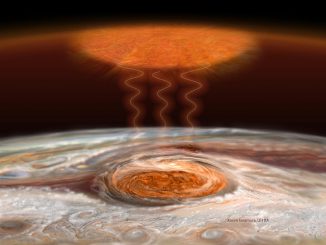
Jupiter’s Great Red Spot heats planet’s upper atmosphere

27 July 2016 Astronomy Now

Astronomers from Boston University have discovered that Jupiter’s Great Red Spot (GRS) may provide the mysterious source of energy required to heat the planet’s upper atmosphere to the unusually high values observed. Heating in Jupiter’s atmosphere 500 miles above the GRS is thought to be caused by gravity waves and acoustic waves creating turbulent atmospheric flows.

Latest Issue

Astronomy Now Newsletter

Get the wonders of the Universe delivered to your inbox. Sign up before 24 September for a 10% discount code for your Stargazer's Guide 2027!
* indicates required
Which elements of Astronomy interest you?

News Headlines

  • 3I/ATLAS was born in the deep freeze
    8 September 2026
  • Roman Space Telescope launches on mission to survey the Universe
    30 August 2026
  • JWST’s ‘impossible’ early galaxies may be even more massive than we thought
    24 August 2026
  • How to observe the 12 August 2026 solar eclipse
    7 August 2026
  • Falcon 9 lunar impact: More than a new crater
    5 August 2026

© 2026 Nebula Press Ltd

Astronomy Now