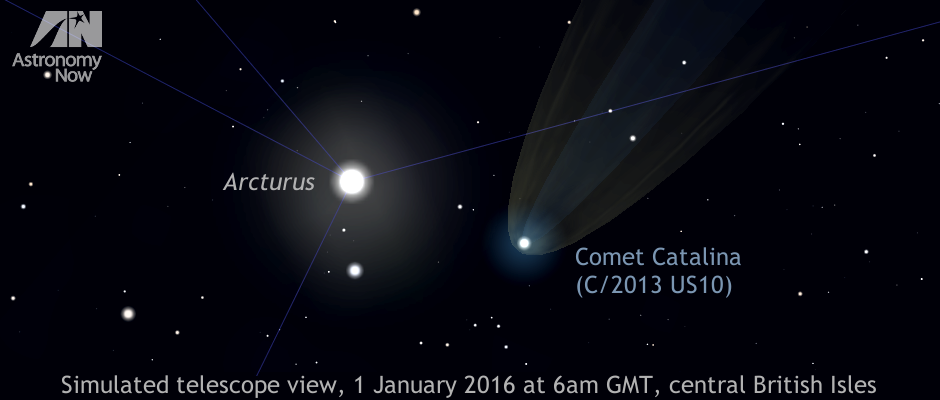
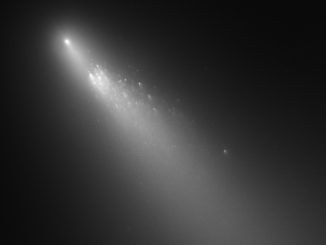
Comet C/2013 US10 Catalina’s rapid ascent into the Northern Hemisphere sky is easy to understand when one realises that its motion through the constellation Boötes is directed close to the celestial pole at a rate of almost 1½ degrees per day — and accelerating. The comet passes less than ½ degree from Arcturus on the morning of New Year’s Day 2016. By the time it crosses into Canes Venatici on 8 January 2016, Comet Catalina is covering around 2½ degrees per day against the background stars. The comet’s position is shown for 06h UT on the stated date, around the time the comet is highest in the sky before dawn twilight for UK observers. Click the graphic for a greyscale version suitable for printing and use outside. AN Graphic by Ade Ashford.Discovered on 31 October 2013 by the Catalina Sky Survey, C/2013 US10 is an Oort Cloud comet making its first foray into the inner solar system. Although Comet Catalina hasn’t lived up to the peak magnitude predicted for it, C/2013 US10 is currently about magnitude +7 and is therefore a binocular object under moonless skies, rising in the east-northeast around midnight as seen from the centre of the British Isles at the close of the year.
Despite receding from the Sun, Comet Catalina’s distance from Earth is still decreasing and we make our closest approach on the morning of Sunday, 17 January 2016 at a distance of 67.3 million miles (108.4 million kilometres). At that time it will be situated between M101 and Alcor in Ursa Major and therefore a circumpolar object for UK observers.
The comet’s track is currently directed close to the north celestial pole, so its motion is largely in declination. C/2013 US10 crossed the constellation border from Virgo into Boötes on Christmas Eve and it passes within ½ degree of the brightest star in the northern celestial hemisphere — magnitude +0.1 Arcturus — on the morning of 1 January 2016.AN graphic by Ade Ashford.If you are still awake in the small hours after the New Years celebrations, you may care to look for the faint fuzz ball of Comet Catalina in your telescope, just 0.6 degrees southwest of Arcturus. You need to select your lowest magnification eyepiece, edging the star just outside the field of view to remove glare, aiding detection of the magnitude +7 comet. There will also be the glow of a waning gibbous Moon in Virgo some 40 degrees away, situated a low power binocular field away from Jupiter.
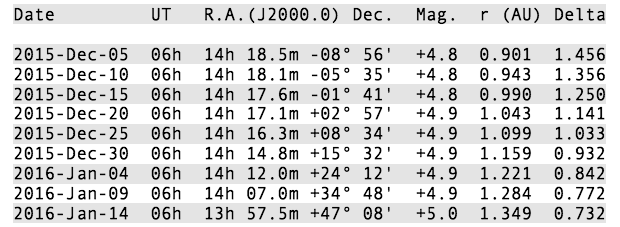
The following J2000.0 topocentric coordinates of Comet Catalina for the centre of the British Isles are for 06h UT on the dates shown. They include optimistic predicted magnitudes (Mag.) with distances in astronomical units (1 AU = 92,955,807.3 miles or 149,597,870.7 kilometres) from both the Sun (r) and the Earth (Delta).
Inside the magazine
You can find out more about Comet Catalina and this month’s planetary events in the December edition of Astronomy Now in addition to a full guide to the night sky.
Pale Red Dot is an international search for an Earth-like exoplanet around the closest star to us, Proxima Centauri. It will be one of the few outreach campaigns allowing the general public to witness the scientific process of data acquisition in modern observatories via blog posts and social media updates. The Pale Red Dot campaign will run from January to April 2016.
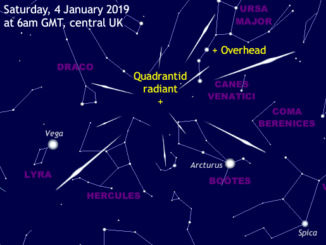
For an early astronomical treat to usher in the New Year, seek out the natural pyrotechnics of the rich Quadrantid meteor shower. Peak shooting star activity occurs within a four-hour window centred on a prediction of 8am GMT on 4 January 2020 – a time that favours UK skywatchers at astronomical dawn, or North American observers around local midnight.
A new study reveals similarities and relationships between certain types of chemicals found on 30 different comets, which vary widely in their overall composition compared to one another. The research is part of ongoing investigations into these primordial bodies, which contain material largely unchanged from the solar system’s birth some 4.6 billion years ago.