Get ready for a month packed full of thrilling Moon-related events! From occultations of stars and planets, and even an eclipse, the Moon has some treats in store for astronomers around the world.
List organised by date:
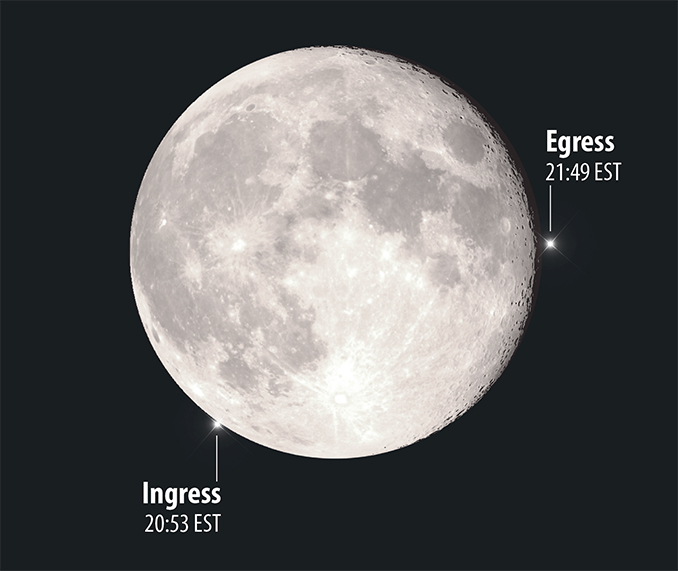
2 February, North America: Regulus engulfed
The early evening of 2 February sees magnitude +1.36 Regulus, Leo’s alpha star, move behind the bright limb of dazzling waning gibbous Moon just a day removed from full phase. This event is visible across most of the USA and Canada. In New York, Regulus is swallowed up on 2 February at 20:53 EST, only to reappear at 21:49 at the slither of darkness of the Moon’s dark limb.
14 February, New Zealand: Moon in the Teapot
In the morning of 14 February a waning crescent Moon (phase 15 per cent) occults magnitude +3.1 phi Sagittarii, one of the stars in the well known ‘Teapot’ asterism of bright stars in Sagittarius.
In Wellington, North Island, the Moon is rising as the star disappears at the Moon’s bright limb on 14 February at 03:41 NZDT, but by the time it pops back into view at the dark limb, at 04:37, phi Sgr is nearly 20 degrees high. Timings are a few minutes later for Dunedin, South Island.
17 February, Southern/Indian Ocean: Annular/partial eclipse of the Sun
An annular ‘ring of fire’ eclipse of the Sun occurs on 17 February, with a narrow path of annularity from the Southern Ocean south of Australia to Antarctica. Unlike at a total eclipse of the Sun the Moon’s shadow stops just short of Earth’s surface, leaving a thin band of the Sun’s blinding photosphere encircling the Moon’s silhouette.
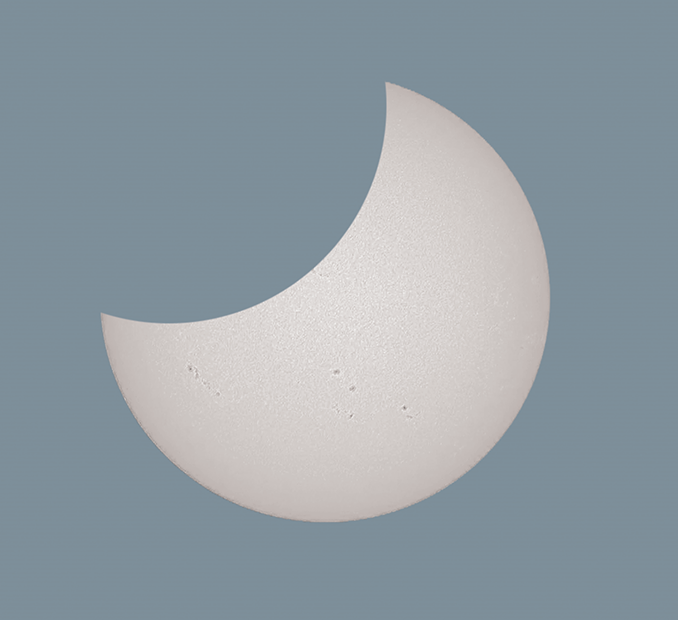
Concordia Station in Antarctica experiences an annular eclipse lasting 2 minutes and five seconds, with maximum eclipse occurring at 19:47:43 local time (UT +8 hours), though the Sun is just 5 degrees high. The partial phases of the eclipse take place between 09:57 to 14:27 UT, covering much of Antarctica and extending just far enough north to include the extreme southern tip of South America, south-eastern Africa and the Indian Ocean islands of Madagascar, Mauritius and The Seychelles.
If you’re in Mauritius there’s a chance to see a large partial eclipse between 16:39 to 18:25 local time (UT +4 hours), with 43.5 per cent of the Sun’s diameter hidden by the Moon (eclipse magnitude) at 17:34. Major cities in South Africa experience a smaller partial eclipse; Cape Town 0.126 magnitude at maximum at 14:43 local time (UT +2 hours), Johannesburg (0.167 at 15:11) and Durban (0.271 at 15:05).
19 February, New Zealand to Mexico: Mercury occulted in daytime
The Moon occults Mercury on 19 February in a day-time event visible across New Zealand. From Wellington, Mercury (RA 23h 15.3m, Dec +17° 06.3’) is hidden behind a slimline Moon (phase 2.2 per cent) from 09:59 until 11:02 NZDT (UT +13 hours), with Mercury’s disappearance at the Moon’s dark limb occurring when the pair are rising and just 17 degrees up in the east.
In Australia, just Mercury’s reappearance is visible, at 08:52 local daylight savings time (UT +11 hours), but it’s only 10 and 5 degrees up in Sydney and Melbourne, respectively.
The occultation zone also includes Mexico and clips Texas, USA. In Houston, Mercury is occulted in strong twilight at 18:36 CST (UT –6 hours), with the setting Moon just 12 degrees high in the west.
24, 27, 28 Feb, UK: Moon brushes Pleiades and Beehive
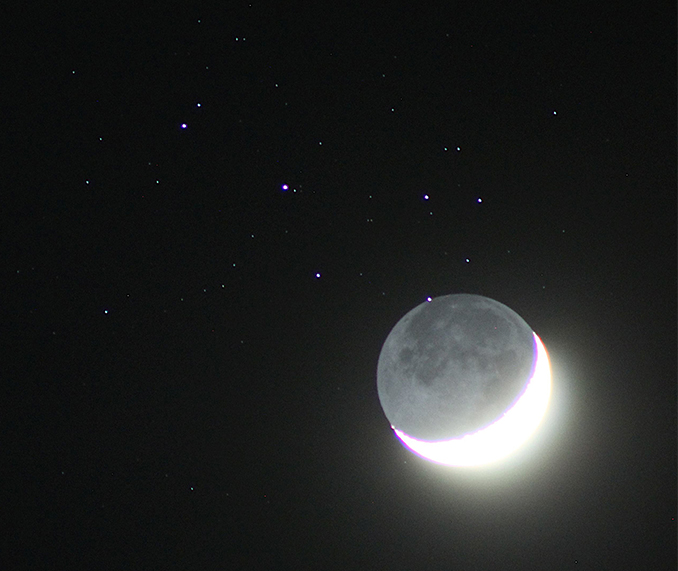
On 24 February at midnight a near first quarter Moon lies low in west-northwest, just 2 degrees west of Electra, the westernmost Pleiad of the Pleiades. The Moon later occult Electra, but, unfortunately, has set in UK skies by this time. On 28 February, at nightfall a waxing gibbous Moon lies just under a degree north of the Beehive Cluster.
On the late evening of 27 February, a pair of binoculars or a small telescope shows magnitude +3.6 kappa (k) Geminorum disappearing at the dark limb of an 85 per cent illuminated gibbous Moon. The star winks out at 21:34 and 21:46 GMT from Edinburgh and London, respectively, reappearing at the Moon’s bright limb at 22:36 and 22:41.
If you capture any of these events on camera, do share your images via gallery2026@astronomynow.com – we may feature your images in future web or print articles, or on our social media channels.
Based on the article “The Moon in action worldwide” by Mark Armstrong, published in the February 2026 issue of Astronomy Now.