
News

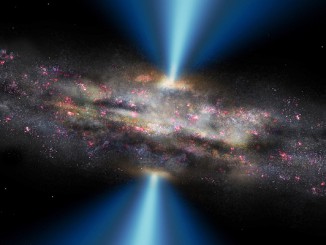
Astronomers have spotted a super-sized black hole in the early universe that grew much faster than its host galaxy. The discovery challenges previous notions about the way host galaxies grow in relation to black holes and casts doubt on earlier suggestions that the radiation emitted by expanding black holes curtails the creation of stars.
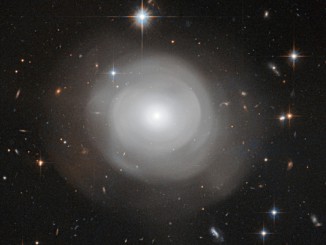
The ghostly shells of galaxy ESO 381-12 are captured here in a new image from the NASA/ESA Hubble Space Telescope, set against a backdrop of distant galaxies. Some 270 million light-years from Earth in the constellation of Centaurus, ESO 381-12 is categorised as a lenticular galaxy — a hybrid type that shares properties with both spiral and elliptical galaxies.

On the final day of NAM2015, science writer Kulvinder Singh Chadha investigates a new model that generates accurate predictions of irregularities within the Sun’s 11-year heartbeat, suggesting that solar activity could fall by 60 percent during the 2030s to ‘mini ice age’ conditions. Kulvinder also looks back at the lighter moments and highlights of a successful conference.

Now just five days away from its close encounter with dwarf planet Pluto, NASA’s New Horizons spacecraft beams back the first image to be received since the 4 July anomaly that sent the spacecraft into safe mode, indicating that all systems appear to be functioning normally. The flyby sequence of science observations is officially underway.
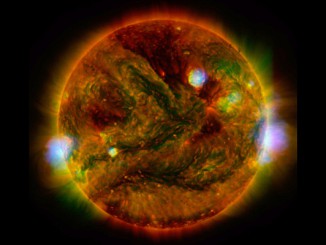
In his third report from the Royal Astronomical Society’s NAM2015, Kulvinder Singh Chadha examines the Sun in X-ray and ultraviolet wavelengths from three different spacecraft, dons a virtual reality planetarium headset, and investigates if the proposed James Webb Space Telescope (JWST) could discern Earth-sized worlds that are habitable.
Authors Couper and Henbest are great storytellers with an eye for a colourful character, says reviewer Andy Sawers. Novice stargazers looking for an introduction to the great milestones and personalities of astronomy will want to read it, while knowledgeable astronomers will enjoy the enthusiastic storytelling, he adds.

Edgar Williams’ book examines the psychological, philosophical and spiritual significance of our nearest neighbour in space. Reviewer Ian Welland states that the author had done extensive research, but the book should be considered a cultural and historical account of our interpretation of the Moon, rather than a full scientific account.

Space artist and author Michael Carroll takes you on a voyage of discovery through the outer Solar System, exploring not only the science of these worlds, but lets your imagination soar to picture what it would be like to stand on Ganymede or Titan. “Carroll’s artwork is stunning… this brilliant book will have you hooked from the beginning,” says reviewer Keith Cooper.
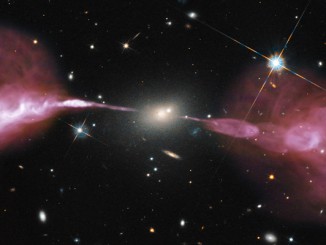
In his second report from the Royal Astronomical Society’s National Astronomy Meeting 2015, Kulvinder Singh Chadha ponders the nature of dark matter and whether cosmic jets — jets of material from active galaxies travelling close to the speed of light — may correlate with dense regions of dark matter in the Universe.
© 2019 Pole Star Publications Limited