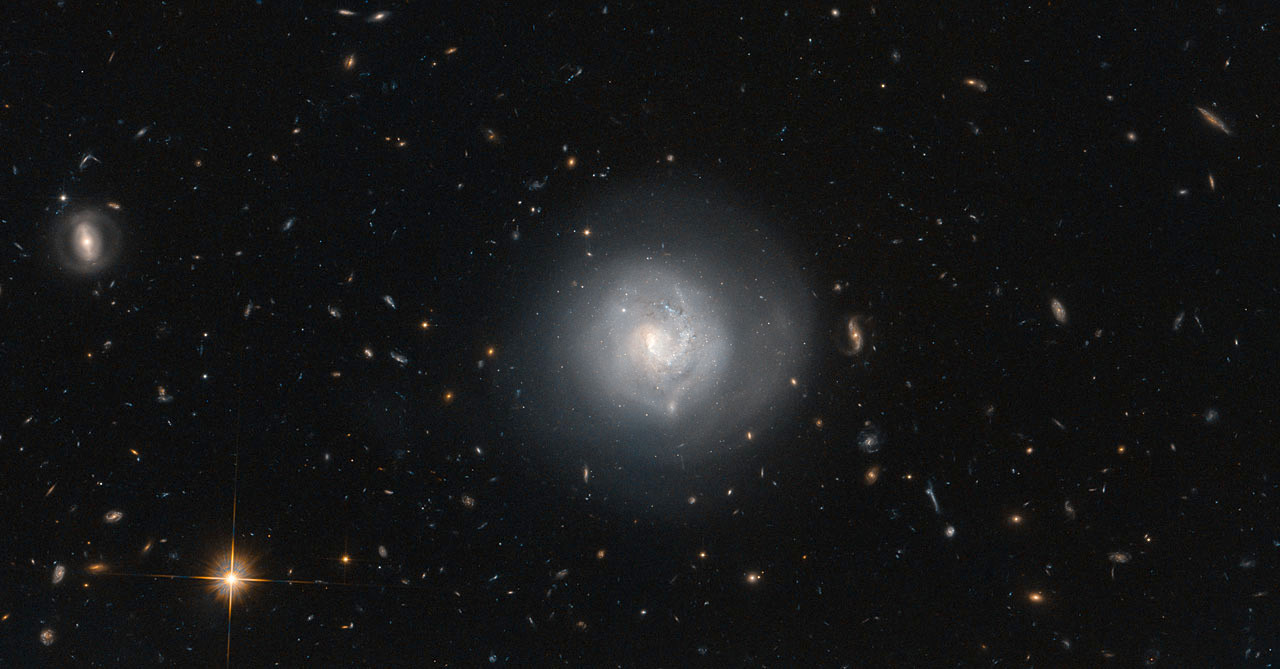
This Hubble image shows the lenticular galaxy Markarian 820, also known as Mrk 820. It lies in the constellation Boötes, about 300 million light-years from Earth. Image credit: ESA/Hubble & NASA and N. Grogin (STScI), Acknowledgement: Judy Schmidt.This galaxy is known as Mrk 820 and is classified as a lenticular galaxy — type S0 on the Hubble Tuning Fork. The Hubble Tuning Fork is used to classify galaxies according to their morphology. Elliptical galaxies look like smooth blobs in the sky and lie on the handle of the fork. They are arranged along the handle based on how elliptical they are, with the more spherical galaxies furthest from the tines of the fork, and the more egg-shaped ones closest to the end of the handle where it divides. The two prongs of the tuning fork represent types of unbarred and barred spiral galaxies.American astronomer Edwin Hubble developed a classification scheme of galaxies in 1926. Although this scheme, also known as the Hubble Tuning Fork diagram, is now considered somewhat too simple, the basic ideas still hold. The diagram is roughly divided into two parts: elliptical galaxies (ellipticals) and spiral galaxies (spirals). “S0,” or lenticular galaxies such as Mrk 820 are in the transition zones between ellipticals and spirals and bridge these two types. Image credit: NASA & ESA.Lenticular galaxies like Mrk 820 are in the transition zone between ellipticals and spirals and lie right where the fork divides. A closer look at the appearance of Mrk 820 reveals hints of a spiral structure embedded in a circular halo of stars.
Surrounding Mrk 820 in this image is a good sampling of other galaxy types, covering almost every type found on the Hubble Tuning Fork, both elliptical and spiral. Most of the smears and specks are distant galaxies, but the prominent bright object at the bottom is a foreground star called TYC 4386-787-1.
It’s time to direct your attention skyward for some celestial pyrotechnics from the first major annual meteor shower — the Quadrantids. The short-lived peak of this active shower is predicted to occur at 2pm GMT on 3 January, favouring observers in the west of North America, but most Northern Hemisphere observers with clear skies will still see some shooting stars.
This NASA/ESA Hubble Space Telescope image shows star clusters encircling a galaxy, like bees buzzing around a hive. The hive in question is the edge-on lenticular galaxy NGC 5308, located just under 100 million light-years away in the constellation of Ursa Major. On 9 October 1996, one of NGC 5308’s aging stars exploded as a spectacular Type la supernova.
Comet 45P/Honda–Mrkos–Pajdušáková passes just 0.08318 astronomical units (7.73 million miles, or ~32 lunar distances) from Earth on the morning of 11 February. Early risers can catch the magnitude +7 comet speeding through the constellations of Hercules, Corona Borealis (CrB) and Boötes at up to 9 degrees/day.