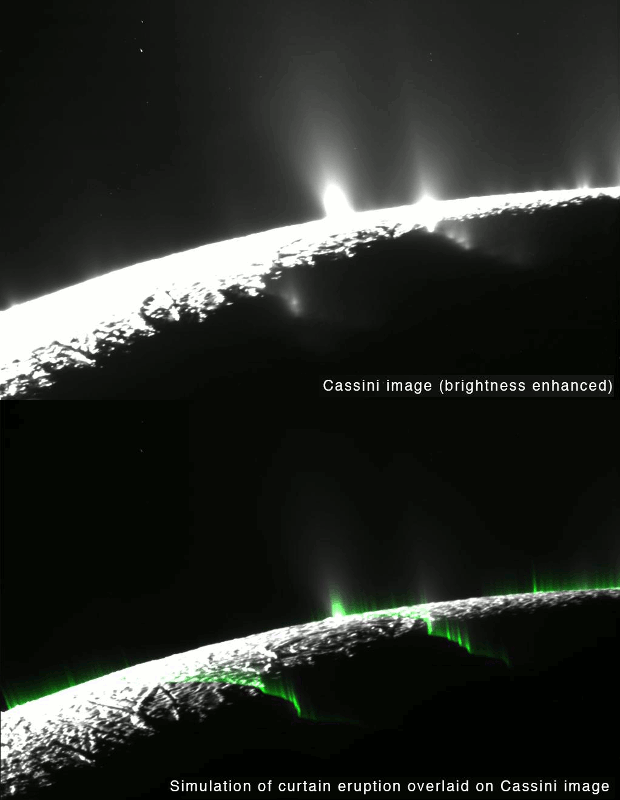
Saturn’s moon Enceladus is geologically active and thought to have a liquid water ocean beneath its icy surface, the presumed source of the plumes of water vapour and ice that NASA’s Cassini spacecraft has observed venting from the moon’s south polar region. A new chemical model constrained by observational data from two Cassini teams shows that the plumes, and by inference the ocean, is salty with an alkaline pH of about 11 or 12. Other research suggests much of the eruption activity could be in the form of broad, curtain-like eruptions, rather than discrete jets. Image credit: NASA/JPL-Caltech/SSI/PSI, AN animation: Ade AshfordSaturn’s sixth-largest moon Enceladus is geologically active and thought to have a liquid water ocean beneath its icy surface. The hidden ocean is the presumed source of the plume of water vapour and ice that the Cassini spacecraft has observed venting from the moon’s south polar region. Whenever there’s the possibility of liquid water on another planetary body, scientists begin to ask whether or not it could support life.
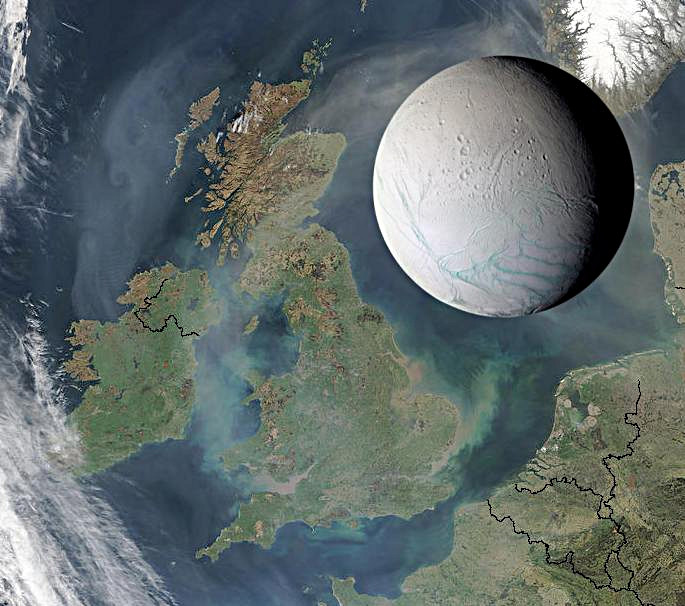
Saturn’s moon Enceladus is only 314 miles (505 kilometres) across, small enough to fit within the length of the United Kingdom. Image credit: NASA/JPL/Space Science Institute.The present team, including lead author Christopher Glein, John Baross of the University of Washington, and J. Hunter Waite Jr. of the Southwest Research Institute, developed a new chemical model based on mass spectrometry data of ice grains and gases in Enceladus’ plume gathered by Cassini, in order to determine the pH of Enceladus’ ocean. The pH tells us how acidic or basic the water is. It is a fundamental parameter to understanding geochemical processes occurring inside the moon that are considered important in determining Enceladus’ potential for acquiring and hosting life. Their work is published in the journal Geochimica et Cosmochimica Acta.
The team’s model, constrained by observational data from two Cassini teams, including one led by coauthor Waite, shows that the plume, and by inference the ocean, is salty with an alkaline pH of about 11 or 12, which is similar to that of glass-cleaning solutions of ammonia. It contains the same sodium chloride (NaCl) salt as our oceans here on Earth. Its additional substantial sodium carbonate (Na2CO3) makes the ocean more similar to our planet’s soda lakes such as Mono Lake in California or Lake Magadi in Kenya. The scientists refer to it as a “soda ocean.”
“Knowledge of the pH improves our understanding of geochemical processes in Enceladus’ ‘soda ocean,'” Glein explained.
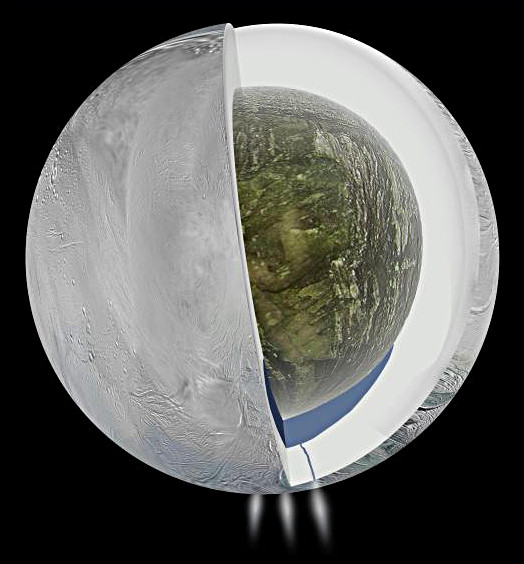
A diagram illustrating the possible interior of Saturn’s moon Enceladus, including the ocean and plumes in the south polar region, based on NASA’s Cassini spacecraft observations. Image credit: NASA/JPL-Caltech.The model suggests that the ocean’s high pH is caused by a metamorphic, underwater geochemical process called serpentinisation. On Earth, serpentinisation occurs when certain kinds of so-called “ultrabasic” or “ultramafic” rocks (low in silica and high in magnesium and iron) are brought up to the ocean floor from the upper mantle and chemically interact with the surrounding water molecules. Through this process, the ultrabasic rocks are converted into new minerals, including the mineral serpentine, after which the process is named, and the fluid becomes alkaline. On Enceladus, serpentinisation would occur when ocean water circulates through a rocky core at the bottom of its ocean.
“Why is serpentinisation of such great interest? Because the reaction between the metallic rocks and the ocean water also produces molecular hydrogen (H2), which provides a source of chemical energy that is essential for supporting a deep biosphere in the absence of sunlight inside moons and planets,” Glein said. “This process is central to the emerging science of astrobiology, because molecular hydrogen can both drive the formation of organic compounds like amino acids that may lead to the origin of life, and serve as food for microbial life such as methane-producing organisms. As such, serpentinisation provides a link between geological processes and biological processes. The discovery of serpentinisation makes Enceladus an even more promising candidate for a separate genesis of life.”
Even beyond the search for life-hosting conditions on other planetary bodies, the team’s work demonstrates that it is possible to determine the pH of an extraterrestrial ocean based on chemical data from a spacecraft flying through a plume. This may be a useful approach to searching for habitable conditions in other icy worlds, such as Jupiter’s moon Europa.
“Our results show that this kind of synergy between observations and modelling can tell us a great deal about the geochemical processes occurring on a faraway celestial object, thus opening the door to an exciting new era of chemical oceanography in the Solar System and beyond.” Glein added.
Astronomers have discovered possible evidence for water on the surface of 16 Psyche, the largest metallic asteroid in the solar system. Measuring 186 miles across and consisting of almost pure nickel-iron metal, Psyche is thought to be the remnant core of a planetary embryo that was mostly destroyed by impacts billions of years ago.
Immediately after its 2008 launch, NASA’s Interstellar Boundary Explorer, or IBEX, spotted a curiosity in a thin slice of space: More particles streamed in through a long, skinny swath in the sky than anywhere else. The origin of the so-called IBEX ribbon was unknown — but its very existence opened doors to observing what lies outside our solar system.
Researchers using data from the Cassini mission have put together a new global spectral map of Enceladus, a moon with icy jets spewing into space from a sub-surface ocean.