6 April 2026
Astronomy Now
  • Home
  • The Magazine
    • About
    • Current Issue
    • Subscribe
    • Renew Subscription
  • AstroFest 2026
  • News
  • Observing
    • UK Sky Chart
    • Almanac
    • Scope Calc
    • DSLR Calc
  • Reviews
    • Equipment
    • Book Reviews
  • Spaceflight Now
  • Shop
  • Contact Us
    • Subscriptions
    • Your Views
    • Ask Astronomy Now
    • Editorial
    • Advertising
    • AstroListings
Latest News
  • [ 2 April 2026 ] Witness to history: Artemis II, lunar exploration and hope News
  • [ 25 March 2026 ] Artificial Intelligence uncovers more than 100 new worlds in NASA data News
  • [ 24 March 2026 ] XRISM solves gamma-Cas’s 50-year X-ray mystery News
  • [ 16 March 2026 ] Molten lava world points to new class of planet Focus on
  • [ 26 January 2026 ] Dr Allan Chapman (1946-2026) News
  • Facebook
  • Twitter
  • LinkedIn

Comet Siding Spring Animation

16 October 2014 Astronomy Now
http://beta.astronomynow.com/wp-content/uploads/2014/10/siding_spring.mp4

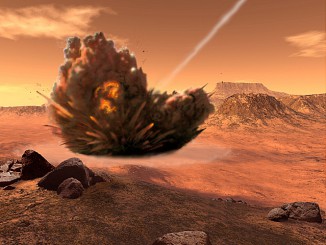
This animation shows Comet Siding Spring’s path as it comes within 132,000 kilometres (82,000 miles) of Mars on 19 October 2014.
  • Animation
  • Comet
  • Comet Siding Spring
  • Mars

Related Articles

News

Mars methane mystery deepens with ExoMars data

16 April 2019 Astronomy Now

In contrast to earlier observations, the ESA-Rososmos ExoMars Trace Gas Orbiter has found a surprising absence of methane in the martian atmosphere.

News

’Oumuamua was a unique object. Now astronomers think there could be trillions just like it

14 April 2020 Keith Cooper

The mysterious interstellar object 1I/‘Oumuamua, and trillions of others like it, could have formed when its parent body was pulled apart by gravitational tides from a star, resulting in elongated shards being ejected into interstellar space.

News

Early Mars bombardment likely enhanced its habitability

6 April 2016 Astronomy Now

Much of the action on Mars occurred during a period known as the Late Heavy Bombardment about 3.9 billion years ago. Large comets and asteroids raining down on the planet would have produced enough heat to melt subsurface ice, likely enhancing climate conditions enough to make Mars more conducive to life — at least for a time.

Latest Issue

Astronomy Now Newsletter

Join our mailing list.
* indicates required
Which elements of Astronomy interest you?

News Headlines

  • Witness to history: Artemis II, lunar exploration and hope
    2 April 2026
  • Artificial Intelligence uncovers more than 100 new worlds in NASA data
    25 March 2026
  • XRISM solves gamma-Cas’s 50-year X-ray mystery
    24 March 2026
  • Molten lava world points to new class of planet
    16 March 2026
  • Dr Allan Chapman (1946-2026)
    26 January 2026

© 2019 Pole Star Publications Limited

Astronomy Now