
3 September 2026
Astronomy Now
  • Home
  • The Magazine
    • About
    • Current Issue
    • Subscribe
    • Renew Subscription
  • AstroFest 2026
  • News
  • Observing
    • UK Sky Chart
    • Almanac
    • Scope Calc
    • DSLR Calc
  • Reviews
    • Equipment
    • Book Reviews
  • Spaceflight Now
  • Shop
  • Contact Us
    • Subscriptions
    • Your Views
    • Ask Astronomy Now
    • Editorial
    • Advertising
    • AstroListings
Latest News
  • [ 30 August 2026 ] Roman Space Telescope launches on mission to survey the Universe News
  • [ 24 August 2026 ] JWST’s ‘impossible’ early galaxies may be even more massive than we thought News
  • [ 7 August 2026 ] How to observe the 12 August 2026 solar eclipse Eclipse
  • [ 5 August 2026 ] Falcon 9 lunar impact: More than a new crater News
  • [ 25 July 2026 ] Euclid opens a new window on the first billion years of cosmic history News
  • Facebook
  • Twitter
  • LinkedIn

Silica

News

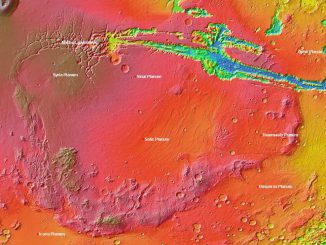
Unusual Martian region leaves clues to planet’s past

27 September 2016 Astronomy Now

Researchers studying the geography and mineralogy of an area on Mars known as Thaumasia Planum, based on Gamma Ray Spectrometer data collected by the Mars Odyssey Orbiter launched in 2001, have found that the mountain ridge outlining Greater Thaumasia was most likely created by a chain of ancient volcanoes.

Latest Issue

Astronomy Now Newsletter

Get the wonders of the Universe delivered to your inbox. Sign up before 24 September for a 10% discount code for your Stargazer's Guide 2027!
* indicates required
Which elements of Astronomy interest you?

News Headlines

  • Roman Space Telescope launches on mission to survey the Universe
    30 August 2026
  • JWST’s ‘impossible’ early galaxies may be even more massive than we thought
    24 August 2026
  • How to observe the 12 August 2026 solar eclipse
    7 August 2026
  • Falcon 9 lunar impact: More than a new crater
    5 August 2026
  • Euclid opens a new window on the first billion years of cosmic history
    25 July 2026

© 2026 Nebula Press Ltd

Astronomy Now