
17 September 2026
Astronomy Now
  • Home
  • The Magazine
    • About
    • Current Issue
    • Subscribe
    • Renew Subscription
  • AstroFest 2026
  • News
  • Observing
    • UK Sky Chart
    • Almanac
    • Scope Calc
    • DSLR Calc
  • Reviews
    • Equipment
    • Book Reviews
  • Spaceflight Now
  • Shop
  • Contact Us
    • Subscriptions
    • Your Views
    • Ask Astronomy Now
    • Editorial
    • Advertising
    • AstroListings
Latest News
  • [ 8 September 2026 ] 3I/ATLAS was born in the deep freeze News
  • [ 30 August 2026 ] Roman Space Telescope launches on mission to survey the Universe News
  • [ 24 August 2026 ] JWST’s ‘impossible’ early galaxies may be even more massive than we thought News
  • [ 7 August 2026 ] How to observe the 12 August 2026 solar eclipse Eclipse
  • [ 5 August 2026 ] Falcon 9 lunar impact: More than a new crater News
  • Facebook
  • Twitter
  • LinkedIn

Schröter Effect

Observing

Watch planets Venus and Jupiter converge in the June evening sky

6 June 2015 Ade Ashford

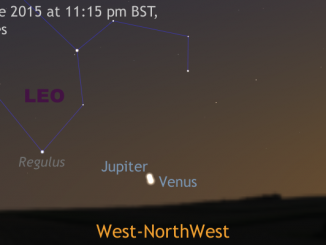
Planet Venus — the brilliant lantern hanging over the west-northwest horizon at dusk — reaches its greatest elongation from the Sun on June 6th. It’s still a month away from reaching peak brightness, but before then it has a spectacular close conjunction with largest planet Jupiter at the end of June.

Latest Issue

Astronomy Now Newsletter

Get the wonders of the Universe delivered to your inbox. Sign up before 24 September for a 10% discount code for your Stargazer's Guide 2027!
* indicates required
Which elements of Astronomy interest you?

News Headlines

  • 3I/ATLAS was born in the deep freeze
    8 September 2026
  • Roman Space Telescope launches on mission to survey the Universe
    30 August 2026
  • JWST’s ‘impossible’ early galaxies may be even more massive than we thought
    24 August 2026
  • How to observe the 12 August 2026 solar eclipse
    7 August 2026
  • Falcon 9 lunar impact: More than a new crater
    5 August 2026

© 2026 Nebula Press Ltd

Astronomy Now