
News


Before sunrise on Thursday 19 January, observers in Western Europe can see an interesting celestial conjunction in the southern sky. At about 6am local time, the waning gibbous Moon, largest planet Jupiter and Spica — the brightest star in the constellation of Virgo — all lie in a line encompassed by the field of view of a typical 7x or 8x binocular.

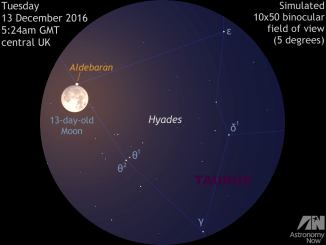
On the night of 12-13 December, the waxing gibbous Moon glides in front of the loose open star cluster known as the Hyades in the constellation of Taurus, culminating in the occultation of bright star Aldebaran around 5:24am GMT for observers in the British Isles. In North America, the event occurs at a more sociable hour late into the evening of 12 December.


Around 6:30am GMT on Friday 25 November, as nautical twilight starts for the centre of the UK, the 25-day-old waning crescent Moon lies just 2½ degrees away from largest planet Jupiter low in the southeastern sky. This juxtaposition of the two brightest objects in the dawn sky will be nicely framed in a typical binocular.

As dusk fades to dark on the evening of Tuesday 15 November, observers in the British Isles and Western Europe can see the rising 16-day-old Moon less than 2 degrees away from Aldebaran in the constellation of Taurus. While an occultation of the star occurs around 17h UT for observers in Japan, central Asia and the Middle East, skywatchers in the UK will have to settle for a near miss.
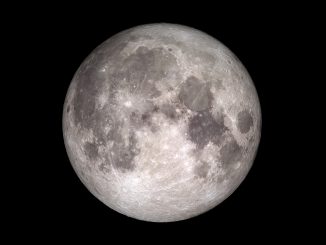
When a full Moon makes its closest pass to Earth in its orbit it appears up to 14 percent bigger and 30 percent brighter than average, making it a supermoon. This month’s full Moon on Monday 14 November is the closest Moon to Earth since 26 January 1948. The Moon won’t be this super again until 25 November 2034!

The penultimate 2016 occultation of Neptune by the Moon occurs on 9 November for observers in Western Asia, Eastern Europe and northernmost Africa. In Western Europe, the nine-day-old waxing gibbous Moon merely brushes by the outermost planet, but the pair will be close enough to be seen within the same field of view of a typical binocular from the UK.
© 2019 Pole Star Publications Limited