Observing

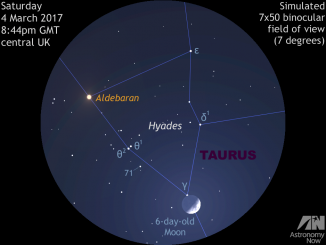
See the Moon glide through the Hyades on 4-5 March

On the night of 4-5 March 2017, UK observers with clear skies can see an occultation bonanza as the 6-day-old waxing crescent Moon passes in front of prominent members of the Hyades open cluster in Taurus. Some hours later, after the Moon has set in the British Isles, first-magnitude star Aldebaran is occulted across a large swathe of North America.

Observing

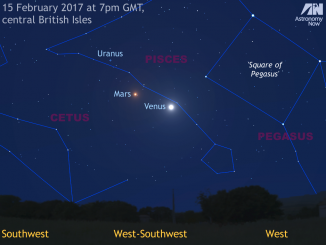
See planet Venus hit peak brightness in the evening sky

Currently setting over four hours after the Sun as seen from the heart of the UK and visible in the west-southwest at dusk, dazzling Venus is about to hit peak brightness in the constellation of Pisces. The planet attains magnitude -4.8 on Friday 17 February — some 21 times the luminosity of brightest star Sirius gracing the southeast horizon as darkness falls.

Observing

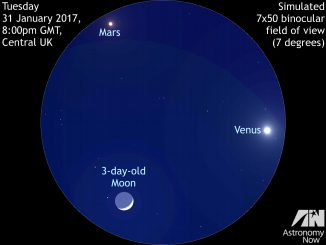
See the Mars-Venus-Moon conjunction of 31 January

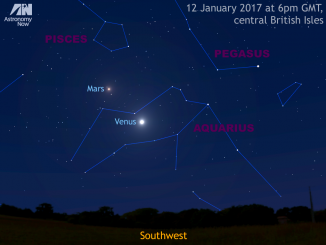
Dazzling Venus and much fainter Mars have a close encounter with a young Moon in the constellation of Pisces at UK dusk on Tuesday 31 January. The trio form an equilateral triangle small enough to be encompassed by the field of view of a 7x binocular low in the west-southwest for a couple of hours from 7pm GMT.

Observing

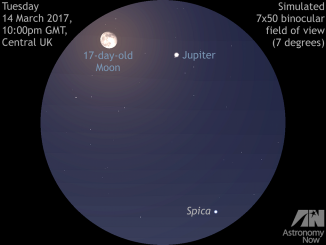
The Moon, Jupiter and star Spica line up at dawn on 19 January

Before sunrise on Thursday 19 January, observers in Western Europe can see an interesting celestial conjunction in the southern sky. At about 6am local time, the waning gibbous Moon, largest planet Jupiter and Spica — the brightest star in the constellation of Virgo — all lie in a line encompassed by the field of view of a typical 7x or 8x binocular.

Observing

See brightest asteroid Vesta at its best

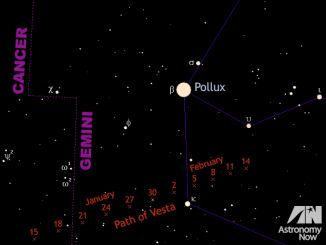
On Wednesday 18 January, brightest asteroid 4 Vesta comes to opposition in the constellation of Cancer bordering on Gemini, ideally placed for observation by Northern Hemisphere skywatchers. While the truly eagle-eyed among you might glimpse it with the unaided eye on dark, moonless nights, Vesta is an easy binocular object.

Observing

Don’t miss the Quadrantid meteor shower’s peak on 3 January

It’s time to direct your attention skyward for some celestial pyrotechnics from the first major annual meteor shower — the Quadrantids. The short-lived peak of this active shower is predicted to occur at 2pm GMT on 3 January, favouring observers in the west of North America, but most Northern Hemisphere observers with clear skies will still see some shooting stars.