26 January 2026
Astronomy Now
  • Home
  • The Magazine
    • About
    • Current Issue
    • Subscribe
    • Renew Subscription
      • September last issue
      • August last issue
      • July last issue
  • AstroFest 2026
  • News
  • Observing
    • UK Sky Chart
    • Almanac
    • Scope Calc
    • DSLR Calc
  • Reviews
    • Equipment
    • Book Reviews
  • Spaceflight Now
  • Shop
  • Contact Us
    • Subscriptions
    • Your Views
    • Ask Astronomy Now
    • Editorial
    • Advertising
    • AstroListings
Latest News
  • [ 16 January 2026 ] Potentially bright ‘sungrazing’ comet discovered News
  • [ 25 October 2025 ] Hubble revisits a cosmic yardstick News
  • [ 21 October 2025 ] Europe’s planet hunting spacecraft complete and ready for final testing News
  • [ 24 September 2025 ] Nova outburst in Centaurus News
  • [ 12 September 2025 ] Astronomy Now relaunches digital platform News
  • Facebook
  • Twitter
  • LinkedIn

News

News

Pioneering probe for gravitational wave observatory ends mission

19 July 2017 Stephen Clark

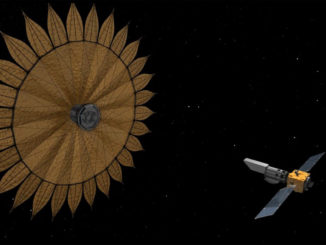
The European Space Agency’s LISA Pathfinder spacecraft, now sailing around the sun on a trajectory away from Earth, was deactivated Tuesday after a nearly 18-month mission testing previously-untried lasers, vacuum enclosures, exotic gold-platinum cubes and micro-thrusters needed for a trio of gravitational wave observatories set for launch in the 2030s.
News

Planets like Earth may have had muddy origins

18 July 2017 Astronomy Now

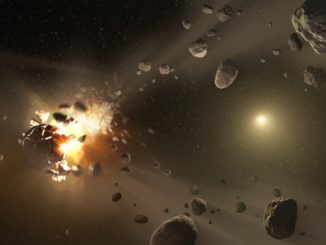
Scientists have long held the belief that planets — including Earth — were built from rocky asteroids, but new research challenges that view.

News

Distant galaxies ‘lift the veil’ on the end of the cosmic dark ages

14 July 2017 Astronomy Now

Astronomers studying the distant universe have found that small star-forming galaxies were abundant when the universe was only 800 million years old, a few percent of its present age. The results suggest that the earliest galaxies, which illuminated and ionized the universe, formed at even earlier times.

News

Heart of an exploded star observed in 3D

13 July 2017 Astronomy Now

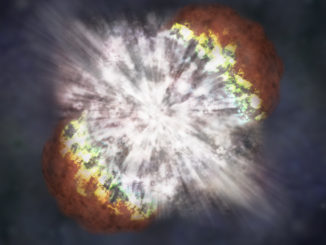
Supernovas — the violent endings of the brief yet brilliant lives of massive stars — are among the most cataclysmic events in the cosmos. Though supernovas mark the death of stars, they also trigger the birth of new elements and the formation of new molecules.

News

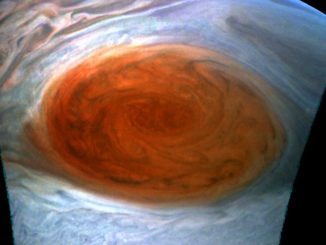
First close up Juno images of Jupiter’s Great Red Spot reach Earth

12 July 2017 William Harwood

Two days after NASA’s Juno spacecraft streaked over Jupiter’s Great Red Spot, pictures of the solar system’s largest, most powerful storm, have been transmitted to Earth, giving eager scientist close-up views of the 10,000-mile-wide anticyclone where 400-mph winds have been howling for at least 187 years and possibly much longer.

News

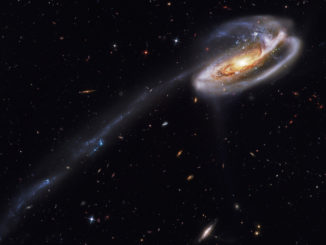
Smallest-ever star discovered by astronomers

12 July 2017 Astronomy Now

The smallest star yet measured has been discovered by a team of astronomers led by the University of Cambridge. With a size just a sliver larger than that of Saturn, the gravitational pull at its stellar surface is about 300 times stronger than what humans feel on Earth.

News

Eight planetary systems found hosting 20 super-Earth & Neptune-mass companions 

12 July 2017 Alex Green

A new treasure trove of planets, ranging from worlds with small masses and short orbital periods of less than 15 days to super-Earth-sized planets that can take up to a year to orbit their star, has been discovered by astronomers using the world’s most successful ground-based planet-finding instrument.

News

BepiColombo Mercury mission tested for journey into ‘pizza oven’

10 July 2017 Stephen Clark

Three spacecraft built in Europe and Japan have completed their final joint tests to ensure they are ready for departure to Mercury on an Ariane 5 rocket late next year on the nearly £1.5 billion BepiColombo mission to survey the Solar System’s innermost planet.

News

Hubble pushed beyond limits to spot clumps of new stars in distant galaxy

10 July 2017 Astronomy Now

When it comes to the distant Universe, even the keen vision of NASA’s Hubble Space Telescope can only go so far. Teasing out finer details requires clever thinking and a little help from a cosmic alignment with a gravitational lens.

News

JAXA, NASA approve replacement for failed Hitomi astronomy satellite

6 July 2017 Stephen Clark

The Japanese space agency is moving ahead with a smaller-scale X-ray astronomy satellite to replace the failed Hitomi observatory, which spun out of control about a month-and-a-half after its launch last year.

Posts pagination

« 1 … 93 94 95 … 218 »

Astronomy Now NewsAlert

Get the latest astronomical news and stargazing tips delivered to your inbox.

News Headlines

  • Potentially bright ‘sungrazing’ comet discovered
    16 January 2026
  • Hubble revisits a cosmic yardstick
    25 October 2025
  • Europe’s planet hunting spacecraft complete and ready for final testing
    21 October 2025
  • Nova outburst in Centaurus
    24 September 2025
  • Astronomy Now relaunches digital platform
    12 September 2025

© 2019 Pole Star Publications Limited

Astronomy Now