News

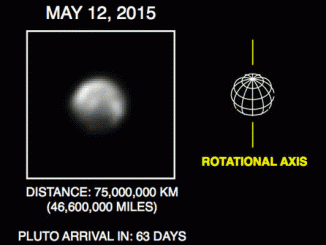
What a difference 20 million miles makes! Images of Pluto from NASA’s New Horizons are growing in scale as the spacecraft approaches its mysterious target. The new images, taken May 8th-12th using a powerful telescopic camera and downlinked last week, reveal more detail about Pluto’s complex and high contrast surface.
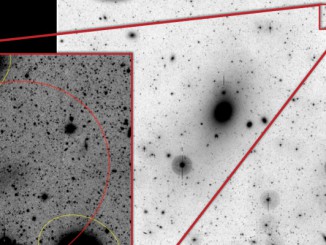
A recent survey using the Canada-France-Hawaii Telescope has discovered hundreds of new galaxies in the Virgo Cluster, the nearest large cluster of galaxies. Most are extremely faint dwarf galaxies, objects hundreds of thousands of times less massive than our Milky Way, and amongst the faintest galaxies known in the universe.
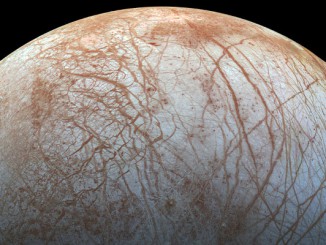
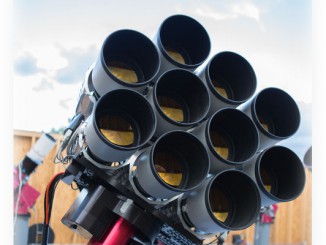
At CASCA 2015, Roberto Abraham from the University of Toronto describes the first results from the Dragonfly Telephoto Array — an innovative, multi-lens system designed to produce digital images of ultra-low surface brightness objects at visible wavelengths — that is at least ten times more efficient than its nearest rival.
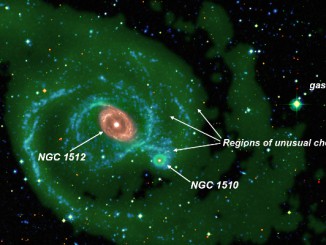
A team of Australian and Spanish astronomers have caught a greedy galaxy gobbling on its neighbours and leaving crumbs of evidence about its dietary past. Their successful and novel approach to investigating how galaxies grow is being used in a new program to further refine the best models of galaxy evolution.


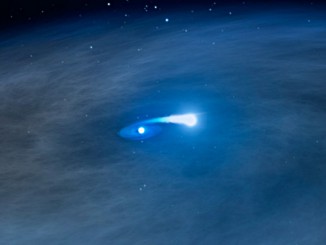
Type Ia supernovae are violent stellar explosions that shine as some of the brightest objects in the universe, but there are still many mysteries surrounding their origin. Now a team of astronomers have witnessed a supernova smashing into a nearby star, shocking it, and creating an ultraviolet glow that reveals the size of the companion.
© 2019 Pole Star Publications Limited