News

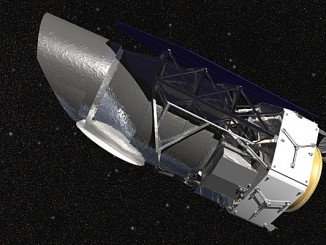
Introducing WFIRST — NASA’s wider set of eyes on the universe

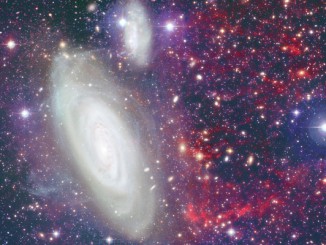
With a view 100 times bigger than that of the Hubble Space Telescope, NASA’s Wide Field Infrared Survey Telescope (WFIRST) will aid researchers in their efforts to unravel the secrets of dark energy and dark matter, and explore the evolution of the cosmos. It also will discover new worlds outside our solar system and advance the search for worlds that could be suitable for life.

News

Did Pluto’s moon Charon possess an ancient subsurface ocean?

This image from NASA’s New Horizons spacecraft focuses on a section of the informally named Serenity Chasma, part of a vast equatorial belt of chasms on Pluto’s largest moon, Charon. Scientists believe that Charon’s subsurface water-ice layer may have been partially liquid in its early history, and has since refrozen, expanded and pushed the surface outward, producing the massive chasms we see today.

News

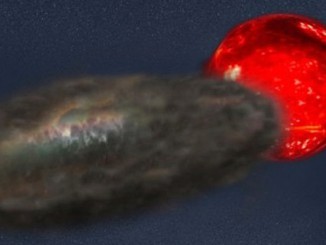
Longest-lasting stellar eclipse discovered

Imagine living on a world where, every 69 years, the sun disappears in a near-total eclipse that lasts for three and a half years. That is just what happens in a newly discovered system, known only by its astronomical catalogue number TYC 2505-672-1, setting a new record for both the longest duration stellar eclipse and the longest period between eclipses in a binary star system.

News

Mystery of disappearing asteroids solved

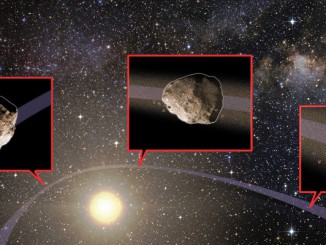
Ever since it was realised that asteroid and comet impacts are a real and present danger to the survival of life on Earth, it was thought that most of those objects end their existence by plunging into the Sun. But a new study finds instead that most of those objects are destroyed in a drawn out, long hot fizzle, much farther from the Sun than previously thought.