News

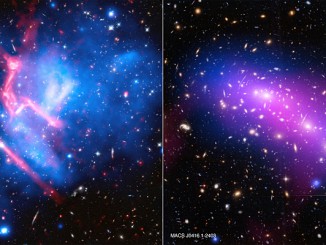
Galaxy clusters are enormous collections of hundreds or even thousands of galaxies and vast reservoirs of hot gas embedded in massive clouds of dark matter. To learn more about clusters, including how they grow via collisions, astronomers have used some of the world’s most powerful X-ray, optical and radio telescopes. The name for this galaxy cluster project is the “Frontier Fields”.
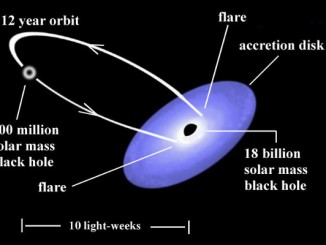
A recent observational campaign involving more than two dozen optical telescopes and NASA’s space-based SWIFT X-ray telescope allowed a team of astronomers to measure very accurately the rotational rate of one of the most massive black holes in the universe. The black hole powers a quasar called OJ 287 which lies about 3.5 billion light-years away from Earth.
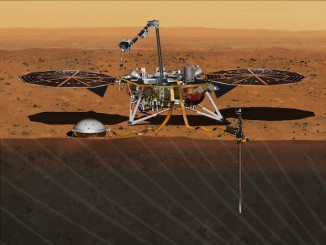
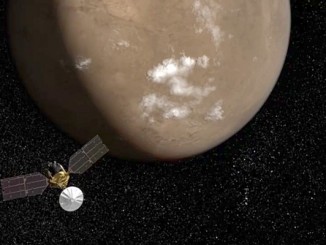
On 10 March 2006, NASA’s Mars Reconnaissance Orbiter (MRO) entered into orbit around the Red Planet. A decade later, with its six science instruments all still operating, MRO has delivered huge advances in knowledge about Mars, revealing in unprecedented detail a world that held diverse wet environments billions of years ago and remains dynamic today.
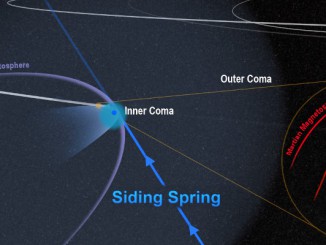
The close encounter between comet Siding Spring and Mars in October 2014 flooded the planet with an invisible tide of charged particles from the comet’s coma, according to data from NASA’s Mars Atmosphere and Volatile Evolution (MAVEN) spacecraft. The comet’s powerful magnetic field temporarily merged with, and overwhelmed, the planet’s weak field.
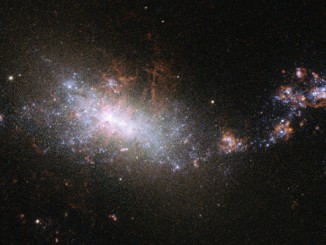
Astronomers have used computer simulations based on theoretical models to explain massive star formation observed in dwarf galaxies. Researchers in the US and the Netherlands found that during a dark matter satellite’s closest approach to a dwarf galaxy, through gravity it compresses the gas in the dwarf, triggering significant episodes of starbursts.
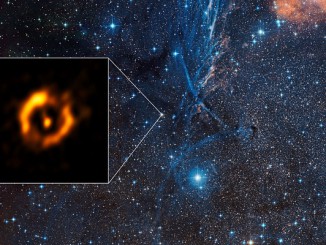
The Very Large Telescope Interferometer at ESO’s Paranal Observatory in Chile has obtained the sharpest view ever of the dusty disc around an ageing star. For the first time such features can be compared to those around young stars — and they look surprisingly similar. It is even possible that a disc appearing at the end of a star’s life might also create a second generation of planets.

Although thick cloud in parts of Indonesia spoiled the view for some along the path of totality, tens of millions more were greeted to spectacular views of the 9 March total solar eclipse. NASA, in partnership with the Exploratorium Science Center, hosted live coverage of the event from the coral island of Woleai in the Pacific Ocean.
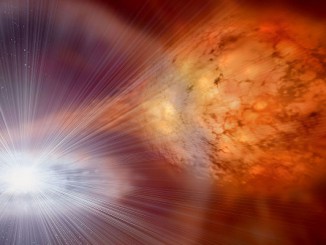
Microscopic particles of stardust, known as “pre-solar grains,” have been found in meteoritic material on Earth. Researchers are investigating whether these particles may have formed in classical novae explosions, ejecting stellar material in the form of gas and dust into the space between stars in the galaxy, eventually to be recycled in the creation of our solar system.
© 2019 Pole Star Publications Limited