News

NASA directly observes fundamental process of nature for first time

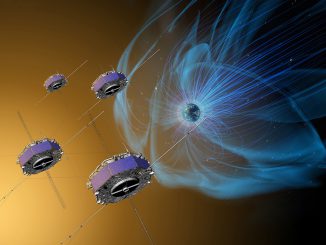
Like sending sensors up into a hurricane, NASA has flown four spacecraft through an invisible maelstrom in space, called magnetic reconnection. Magnetic reconnection is one of the prime drivers of space radiation and so it is a key factor in the quest to learn more about our space environment and protect our spacecraft and astronauts as we explore farther and farther from our home planet.

News

Chandra captures expanding debris from Tycho’s supernova remnant

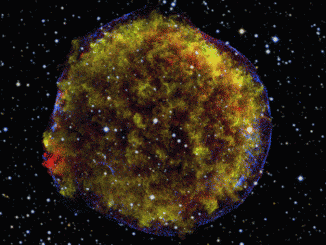
Astronomers have observed the debris field from the supernova of 1572, now known as Tycho’s supernova remnant, with NASA’s Chandra X-ray Observatory and the NSF’s Karl G. Jansky Very Large Array (VLA). By combining the X-ray data with some 30 years of observations in radio waves, astronomers have also produced a movie showing the expansion from the explosion is still continuing 444 years later.

News

Kepler-223 star system has four mini-Neptunes in synchronised orbits

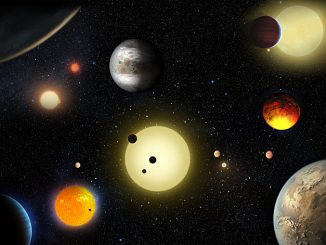
A four-planet system orbiting the star Kepler-223 in the constellation Cygnus is actually a rarity: Its planets, all miniature Neptunes nestled close to the star, are orbiting in a unique resonance that has been locked in for billions of years. For every three orbits of the outermost planet, the second orbits four times, the third six times and the innermost eight times.

News

2007 OR10: the largest unnamed world in the solar system

By combining data from two space observatories, astronomers have revealed something surprising: a 955-mile-wide dwarf planet named 2007 OR10 is significantly larger than previously thought. Although its 547-year-long elliptical orbit brings it nearly as close to the Sun as Neptune, 2007 OR10 is currently twice as far from the Sun as Pluto.

News

Natural causes, not aliens, explain mystery star’s behaviour

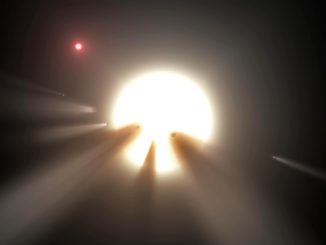
Media interest went viral last October when a group of astronomers from Pennsylvania State University cited that the “bizarre light curve” of KIC 8462852, popularly known as Tabby’s star, was “consistent with” a swarm of alien-constructed megastructures. Now, the results of a new study make it far less likely that KIC 8462852 is the home of industrious extraterrestrials.

News

Astronomers detect double ‘peanut shell’ galaxies

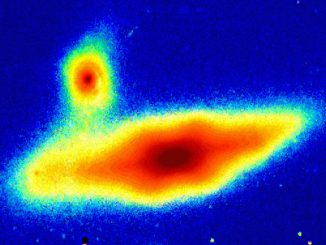
Astronomers at Swinburne University of Technology, Melbourne, have discovered an unusually shaped structure in two nearby disc galaxies. The Swinburne team recently developed new imaging software, making it possible to observe the double “peanut shell shape” formed by the distribution of stars bulging from the centres of these galaxies.