News

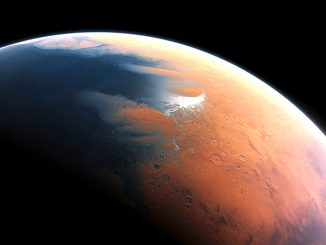
The geologic shape of what were once shorelines through Mars’ northern plains 3.4 billion years ago convinces scientists that two large meteorites – hitting the planet millions of years apart – triggered a pair of mega-tsunamis. These gigantic waves, likely 120 metres high, forever scarred the Martian landscape and yielded evidence of cold, salty oceans.
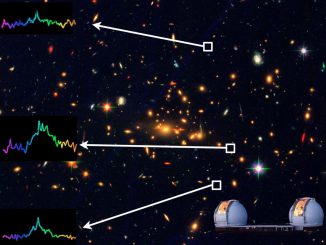
An international team of scientists has detected and confirmed the faintest early-universe galaxy ever using the ten-metre Keck II telescope on the summit on Maunakea, Hawaii. The team analysed three separate images of the object gravitationally lensed by a foreground galaxy cluster, revealing the distant galaxy as it was 13 billion years ago.

Warming up for a possible extended mission as it speeds through deep space, NASA’s New Horizons spacecraft has now twice observed 1994 JR1, a 90-mile-wide Kuiper Belt object (KBO) orbiting more than 3 billion miles from the Sun. Science team members have used these observations to reveal new facts about this distant remnant of the early solar system.
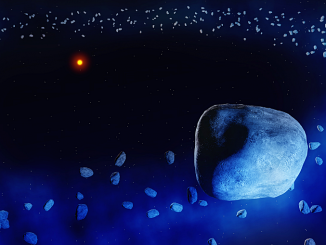
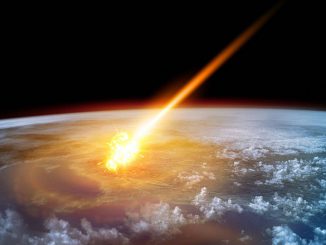
An international team of scientists has found evidence of a major asteroid impact that occurred approximately 3.5 billion years ago. Tiny glass beads called spherules formed from vaporised material from the asteroid impact were found in a drill core from Australia in some of the oldest known sediments on Earth.
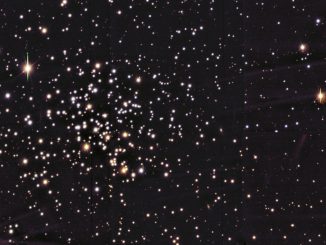
Astrophysicists from Germany and America have for the first time measured the rotation periods of stars in a cluster nearly as old as the Sun. It turns out that these stars spin once in about twenty-six days — just like our Sun. This discovery significantly strengthens what is known as the solar-stellar connection, a fundamental principle that guides much of modern solar and stellar astrophysics.
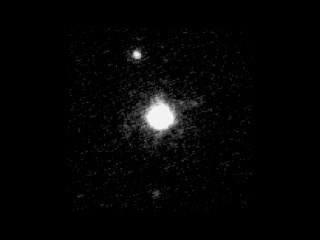
Haumea, a dwarf planet on the edge of our solar system, doesn’t have the same kind of moons as its well-known cousin Pluto according to a new study. This is despite original evidence that suggested they both formed in similar giant impacts and adds to the mystery shrouding how these icy bodies formed.
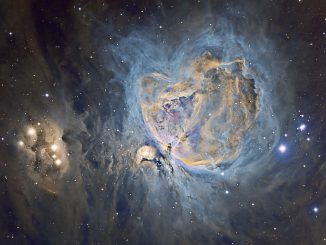
Space bears witness to a constant stream of star births. Whole star clusters are often formed at the same time — and within a comparatively short period. Researchers from the Max Planck Institute for Astronomy in Heidelberg have proposed a new mechanism that relies on the interplay between magnetic fields and gravitation to explain this quick formation, investigating a filament of gas and dust which also includes the well-known Orion Nebula.
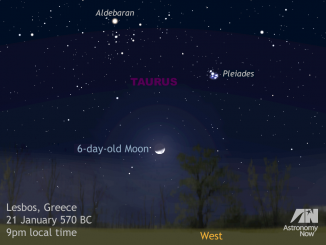
Physicists and astronomers from the University of Texas at Arlington have used advanced software to accurately date lyric poet Sappho’s “Midnight Poem,” which describes the Pleiades star cluster in the constellation of Taurus having set at around midnight, when supposedly observed by her from the Greek island of Lesbos more than 2,500 years ago.
© 2019 Pole Star Publications Limited