News

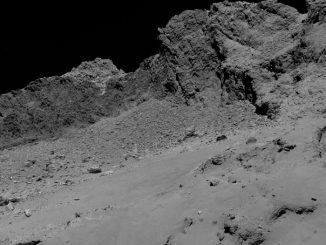
Europe’s Rosetta spacecraft will close out a historic 4.9-billion-mile journey Friday with a slow-speed crash into the nucleus of comet 67P/Churyumov-Gerasimenko, the tiny world it has studied for the last two years, capturing some of the mission’s best science data to help unravel the inner workings of the comet. Confirmation of the crash landing should arrive on Earth around 1218 BST.
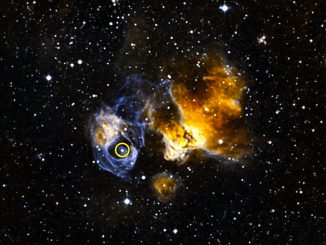
Using data from NASA’s Fermi Gamma-ray Space Telescope and other facilities, an international team has found the first gamma-ray binary in another galaxy and the most luminous one ever seen. The dual-star system, dubbed LMC P3, contains a massive star and a crushed stellar core that interact to produce a cyclic flood of gamma rays.
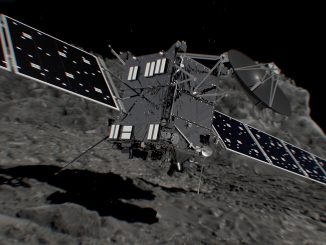
The European Space Agency’s Rosetta spacecraft closed in Thursday for a deliberate crash landing on the surface of comet 67P/Churyumov-Gerasimenko on Friday, a slow-motion kamikaze plunge to bring the enormously successful mission to an end after more than two years of unprecedented close-range observations.
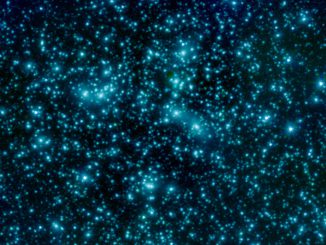
In the ongoing hunt for the universe’s earliest galaxies, NASA has wrapped up its observations for the Frontier Fields project. This ambitious venture has combined the power of all three of NASA’s orbital observatories — the Spitzer Space Telescope, the Hubble Space Telescope and the Chandra X-ray Observatory — to delve as far back in time and space as current technology can allow.
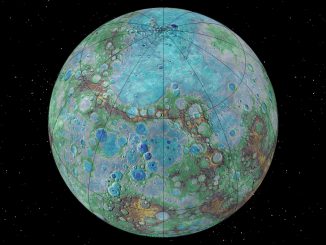
Images from NASA’s MESSENGER spacecraft reveal previously undetected cliff-like landforms on Mercury that scientists believe must be geologically young, which means that the innermost planet is still contracting and that Earth is not the only tectonically active planet in our solar system, as previously thought.
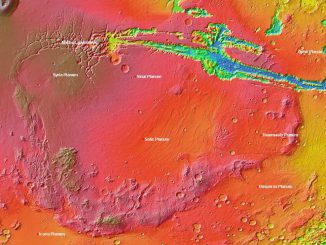
Researchers studying the geography and mineralogy of an area on Mars known as Thaumasia Planum, based on Gamma Ray Spectrometer data collected by the Mars Odyssey Orbiter launched in 2001, have found that the mountain ridge outlining Greater Thaumasia was most likely created by a chain of ancient volcanoes.
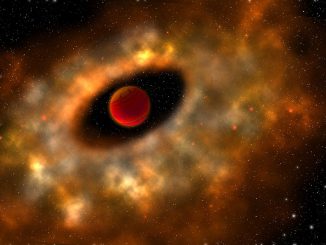
Astronomers like to find rotating primordial discs of gas and dust around young stars from which planets can form. They might be able to catch the star partway through the planet-formation process, but it’s highly unusual to find such discs around brown dwarfs or stars with very low masses. Now, recent work reveals four new low-mass objects surrounded by discs.
© 2019 Pole Star Publications Limited