News

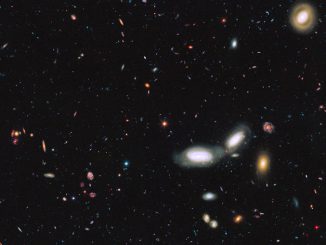
Astronomers using data from the NASA/ESA Hubble Space Telescope and other observatories have performed an accurate census of the number of galaxies in the universe. The researchers came to the surprising conclusion that the observable universe contains at least two trillion galaxies. The results also help solve an ancient astronomical paradox — why is the sky dark at night?
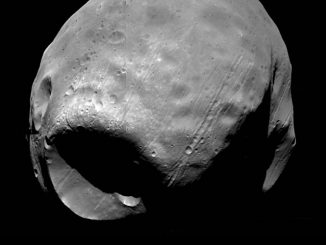
The dominant feature on the surface of Mars’ largest satellite, Phobos, is Stickney — a 9-kilometre-wide mega crater that spans nearly half the moon. The crater lends Phobos a physical resemblance to the planet-destroying Death Star in the film “Star Wars.” But over the decades, understanding the formation of such a massive crater has proven elusive for researchers.

The Moon’s surface is being “gardened” — churned by small impacts — more than 100 times faster than scientists previously thought. This means that lunar surface features believed to be young are perhaps even younger than assumed. It also means that any structures placed on the Moon as part of human expeditions will need better protection.

Ancient variable stars, of a type known as RR Lyrae, have been discovered in the centre of the Milky Way for the first time. RR Lyrae stars typically reside in ancient stellar populations over 10 billion years old, such as globular clusters. These stars may even be the remains of the most massive and oldest surviving star cluster of the entire Milky Way.
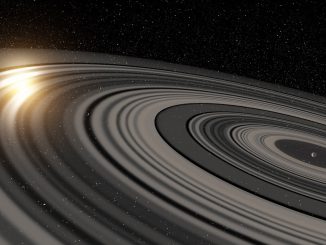
Researchers from Japan and the Netherlands who were previously involved in the discovery of an exoplanet with huge rings have now calculated that the giant rings may persist more than 100,000 years — as long as the rings orbit in the opposite direction compared to that of the planet around the star.
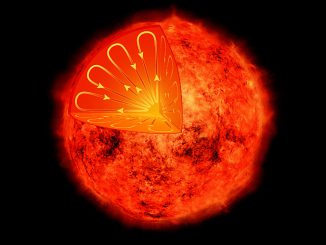
Astronomers recently announced that the nearby star Proxima Centauri hosts an Earth-sized planet in its habitable zone. Proxima Centauri is a small, cool, red dwarf star only one-tenth as massive and one-thousandth as luminous as the Sun. However, new research shows that it is Sun-like in one surprising way: it has a regular cycle of starspots.

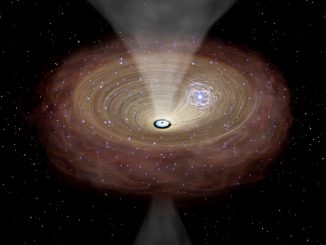
Investigating the millions of missing stars from the centres of two big galaxies, researchers say they may have solved this cosmic whodunit — and the main culprits are not the usual suspects. While the astronomers confirm that one of the depleted cores is the largest ever detected, they report that it may not have formed in the manner previously thought.
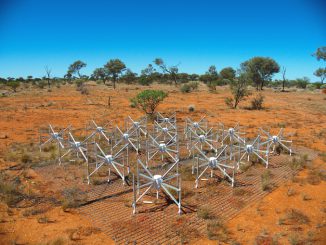
The epoch when the very first stars appeared is a key period of cosmic history. These stars began the manufacture of the chemical elements (those heavier than hydrogen and helium) and their light began the reionisation of the neutral cosmic gas. These stars thus mark the dawn of the universe as we know it today and the start of the so-called Epoch of Reionisation.
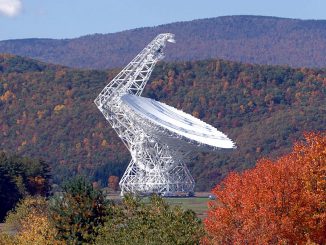
Astronomers have just celebrated the inauguration of the Green Bank Observatory in West Virginia, home to the 100-metre Green Bank Telescope, one of the world’s most powerful astronomical instruments. During its 60-year history, Green Bank has been home to some of the world’s most innovative and productive radio telescopes.
© 2019 Pole Star Publications Limited