Observing

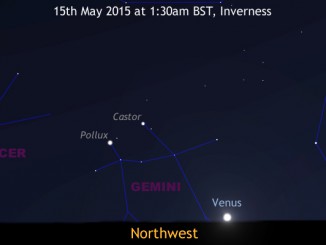
Venus’ late night show in May

Even casual observers cannot fail to notice dazzling Venus currently gracing the western horizon at dusk. Owing to a favourable set of circumstances, the brightest planet is visible long after sunset. How late can you see it set in the British Isles? For those north of the Arctic Circle, Venus is presently circumpolar and doesn’t set at all!

News

Institute for Pale Blue Dots renamed in honour of Carl Sagan

Carl Sagan’s highly inspirational 1980 TV series “Cosmos: A Personal Voyage” launched many a career in astronomy. Now the Carl Sagan Institute: Pale Blue Dot and Beyond — a research institution devoted to the pursuit of Sagan’s challenge to explore other worlds, to learn if they, too, contain life — was unveiled at Cornell University on May 9th.

News

Exo-asteroid debris shows how water reached Earth

New research strongly suggests that water delivery via asteroids or comets is likely taking place in many other planetary systems, adding further support to the possibility water can be delivered to Earth-like planets via such bodies to create a suitable environment for the formation of life.

News

Astronomers set a new galaxy distance record

An international team of astronomers has pushed back the cosmic frontier of galaxy exploration to a time when the universe was only 5 percent of its present age with the discovery of an exceptionally luminous galaxy more than 13 billion light-years from Earth. The galaxy existed so long ago, it appears to be only 100 million years old.

News

First evidence of volcanic activity on a super-Earth?

Astronomers have detected wildly changing temperatures on a super-Earth — the first time any atmospheric variability has been observed on a rocky planet outside the Solar System — and believe it could be due to huge amounts of volcanic activity, further adding to the mystery of what had been nicknamed the ‘diamond planet.’

News

The dark matter conspiracy

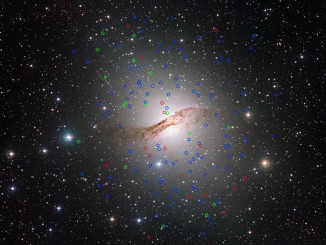
A new study finds that elliptical galaxies maintain a remarkably constant circular speed out to large distances from their centres, in the same way that spiral galaxies do. In these very different types of galaxies, stars and dark matter somehow conspire to redistribute themselves to produce this effect, or does modified Newtonian dynamics offer an explanation?