Picture This

Hubble views the Little Gem Nebula

This colourful bubble is a planetary nebula called NGC 6818, also known as the Little Gem Nebula, discovered by William Herschel in 1787. It is located in the constellation of Sagittarius, roughly 6,000 light-years away from us. The rich glow of the cloud is just over half a light-year across.

News

A new record: Keck Observatory measures most distant galaxy

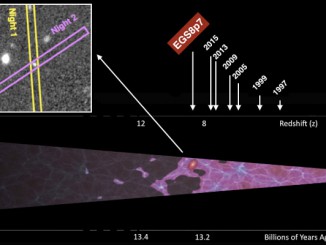
EGSY8p7 is the most distant confirmed galaxy whose spectrum obtained with the W. M. Keck Observatory places it at a redshift of 8.68, at a time when the universe was less than 600 million years old. Hydrogen emission from EGSY8p7 may indicate it is the first known example of an early generation of young galaxies emitting unusually strong radiation.

News

Scientists solve age-old planetary ring riddle

An international team of scientists has solved an age-old scientific riddle by discovering that planetary rings, such as those orbiting Saturn, have a universally similar particle distribution. The study also suggests that Saturn’s rings are essentially in a steady state that does not depend on their history.

Picture This

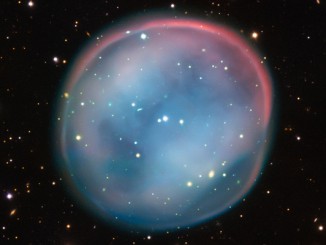
The ghost of a dying star — the Southern Owl Nebula

This extraordinary bubble, glowing like the ghost of a star in the haunting darkness of space, may appear supernatural and mysterious, but it is a familiar astronomical object: a planetary nebula, the remnants of a dying star. This is the best view of the little-known object ESO 378-1 yet obtained and was captured by ESO’s Very Large Telescope in northern Chile.

News

Tracking a mysterious group of asteroid outcasts

High above the plane of our solar system, near the asteroid-rich abyss between the orbits of Mars and Jupiter, scientists have found a unique family of space rocks. These interplanetary oddballs are the Euphrosyne (pronounced ew-FROZ-i-nee) asteroids, and by any measure they have been distant, dark and mysterious — until now.

News

Philae’s descent to comet 67P

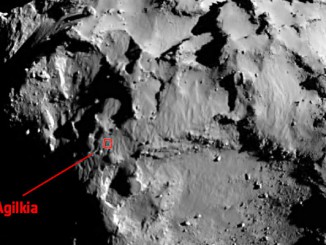
Recently released images compiled into a movie show the descent of the European Space Agency’s Philae lander to its first touchdown site, Agilkia, on Comet 67P/Churyumov–Gerasimenko on 12 November 2014. The image sequence starts just over two miles from the comet, and the final image is from just 9 metres above the landing site.