X-Highlight
Mystery of missing exoplanet water solved using NASA space telescopes
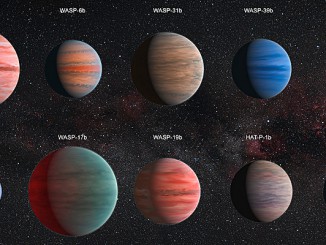
A survey of ten hot, Jupiter-sized exoplanets conducted with NASA’s Hubble and Spitzer telescopes has led a UK-US team to solve a long-standing mystery — why some of these worlds seem to have less water than expected. The findings offer new insights into the wide range of planetary atmospheres in our galaxy and how planets are assembled.
Strange globular cluster recalls Milky Way’s infancy
When our galaxy was born, around 13,000 million years ago, a plethora of clusters containing millions of stars emerged. But over time, they have been disappearing. However, hidden behind younger stars that formed later, some old and dying star clusters remain, such as the so-called E 3. European astronomers have now studied this testimony to the beginnings of our galaxy.
Astronomers recall discovery of Phaethon — source of Geminid meteors
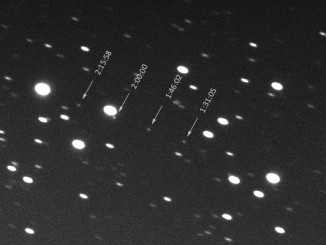
The beautiful Geminid meteor shower is due to light up the heavens this weekend, but the source of the enigmatic cosmic display had eluded stargazers for more than 120 years. Then, in 1983, two University of Leicester astronomers — Dr. Simon Green and Dr. John Davies — used data from the IRAS satellite to discover 3200 Phaethon, an asteroid with a very unusual orbit.
Pluto’s close-up, now in colour
This enhanced colour mosaic combines some of the sharpest views of Pluto that NASA’s New Horizons spacecraft obtained during its 14 July flyby, revealing features smaller than half a city block on the dwarf planet’s surface. The wide variety of cratered, mountainous and glacial terrains seen here gives scientists and the public alike a breathtaking, super-high-resolution colour window into Pluto’s geology.
What spawned the Jellyfish Nebula?
The Jellyfish Nebula, also known by its official name IC 443, is the remnant of a supernova lying 5,000 light-years from Earth. New observations from NASA’s Chandra X-ray Observatory show that the explosion that created the Jellyfish Nebula may have also formed a peculiar object located on the southern edge of the remnant.
NASA telescopes detect Jupiter-like storm on small, cool star
Astronomers using data from NASA’s Spitzer and Kepler space telescopes have discovered what appears to be a Jupiter-sized star with a colossal, cloudy storm with a diameter that could hold three Earths. The storm rotates around the L-dwarf star known as W1906+40 about every 9 hours and has lasted at least two years, probably longer.
NASA applauds Japanese spacecraft Akatsuki’s rendezvous with Venus
Japan’s Akatsuki spacecraft got another shot at Venus after a main engine failure during a crucial orbital-insertion burn meant it zipped past the planet on its first attempt in December 2010. The probe spent five years orbiting the Sun so it could catch up with Venus to try again on 7 December. The successful nail-biting manoeuvre is being celebrated by NASA scientists, eager to learn more about the atmosphere and climate of Earth’s enigmatic sister planet.
New clues to dwarf planet Ceres’ bright spots and origins
The surface of Ceres, whose average diameter is 584 miles, is generally dark and similar in brightness to fresh asphalt. But the dwarf planet does possess 130 mysterious bright areas associated with impact craters that new research suggests are salt-rich areas left behind when briny water-ice from a subsurface layer sublimated in the past.