News

Dawn gets the lowdown on dwarf planet Ceres

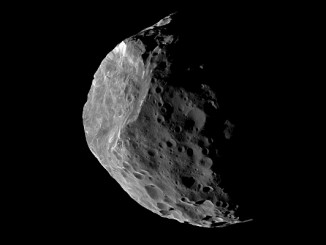
NASA’s Dawn spacecraft, cruising in its lowest and final orbit at dwarf planet Ceres, has delivered the first images from its best-ever viewpoint. The new images showcase details of the cratered and fractured surface. Dawn is now approximately 240 miles (385 kilometres) above Ceres, which is where it will remain for the rest of its mission.
News

Giant comets could pose danger to life on Earth

Over the last two decades, the discovery of hundreds of giant comets, termed Centaurs, on unstable orbits in the outer planetary system means that these objects pose a much greater hazard to life than asteroids, according to a team of UK astronomers. Centaurs are typically 50 to 100 kilometres across, or larger, and a single such body contains more mass than the entire population of Earth-crossing asteroids found to date.

News

Chandra finds a remarkable galactic ribbon unfurled

An extraordinary ribbon of hot gas trailing behind a galaxy like a tail has been discovered using data from NASA’s Chandra X-ray Observatory. This ribbon, or X-ray tail, is likely due to gas stripped from the galaxy as it moves through a vast cloud of hot intergalactic gas. With a length of at least 250,000 light-years, it is likely the largest such tail ever detected.

News

Twisted magnetic fields give new insights on star formation

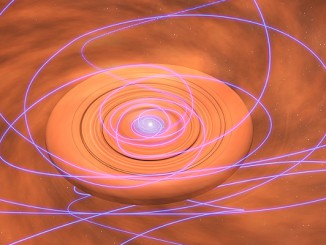
Using new images that show unprecedented detail, scientists have found that material rotating around a very young protostar probably has dragged in and twisted magnetic fields from the larger area surrounding the star. The discovery, made with the Very Large Array radio telescope, has important implications for how dusty discs — the raw material for planet formation — grow around young stars.

News

Discovery of mechanism that halts solar eruptions before they leave the Sun

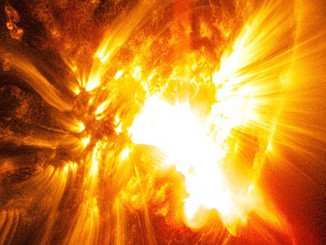
Among the most feared events in space physics are solar eruptions — massive explosions that hurl millions of tons of plasma, gas and radiation into space. These outbursts can be deadly to astronauts and when these eruptions reach the magnetic field that surrounds the Earth, the contact can create geomagnetic storms that disrupt cell ‘phone service, damage satellites and knock out power grids.

Picture This

Hubble finds a festive snow angel

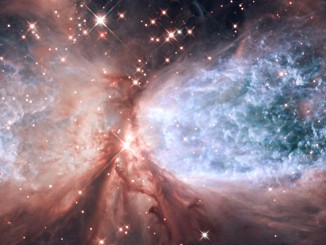
The bipolar star-forming region Sharpless 2-106 some 2,000 light-years away in the constellation Cygnus looks like a soaring, celestial snow angel in this image from the NASA/ESA Hubble Space Telescope. Twin lobes of super-hot gas, glowing blue in this image, stretch outward from the central young and massive star. This hot gas creates the “wings” of our angel.

News

Asteroid 2003 SD220 sleighs by Earth on Christmas Eve

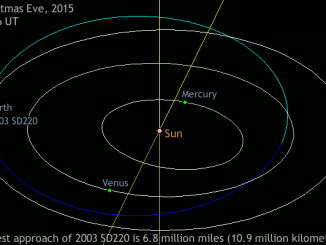
During the month of December, the Planetary Radar Group at Arecibo Observatory has observed near-Earth asteroid 2003 SD220, which will make its closest approach to Earth on Christmas Eve. Although designated as “potentially hazardous,” this asteroid will be 28 times further away than our Moon and therefore poses no present danger to Earth.

News

Gullies on Mars sculpted by dry ice rather than liquid water?

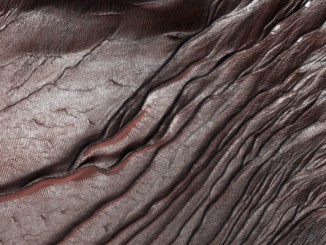
Mars’ gullies may be formed by dry ice processes rather than flowing liquid water, as previously thought. This is the conclusion of a study conducted by two French scientists published in Nature Geoscience. They show that, during Martian late winter and spring, underneath the seasonal CO2 ice layer heated by the Sun, intense gas fluxes can induce gas-lubricated debris flows which look like water-sculpted gullies on Earth.

Picture This

Sparkling Stephan’s Quintet

The Stephan’s Quintet of galaxies in the constellation Pegasus was discovered by astronomer Édouard Stephan in 1877. This image combines observations performed at three different wavelengths, with ESA’s Herschel and XMM-Newton space observatories as well as with ground-based telescopes, to reveal the different components of the five galaxies.