News

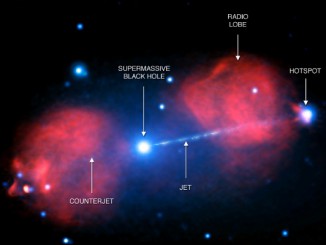
Blast from black hole in distant Pictor A galaxy

By combining X-ray data from NASA’s Chandra X-ray Observatory over a 15-year period with radio data from the Australia Telescope Compact Array, astronomers have a better understanding of the active galaxy Pictor A, the supermassive black hole at its core and the enormous jet of particles it generates travelling at nearly the speed of light into intergalactic space.

Picture This

The unearthly beauty of the Red Rectangle

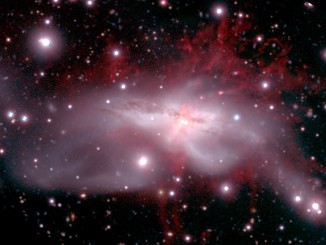
Straight lines do not often crop up in space. Whenever they do, they seem somehow incongruous and draw our attention. The Red Rectangle, a so-called planetary nebula surrounding the double star HD 44179 some 2300 light-years away in the constellation of Monoceros, is one such mystery object.

Picture This

Hubble sees starburst in the maelstrom of a galactic merger

This Hubble image is of the peculiar galaxy NGC 1487, lying about 30 million light-years away. We are witnessing the possible merger of several dwarf galaxies into a new single galaxy. Its appearance is dominated by large areas of bright blue stars, illuminating the patches of gas that gave them life. This burst of star formation may well have been triggered by the merger.

News

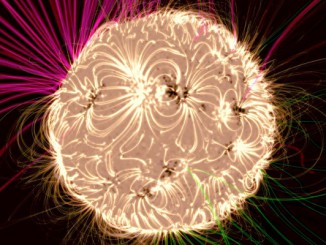
Understanding the magnetic Sun

The Sun’s magnetic field is responsible for everything from the solar explosions that cause space weather on Earth — such as aurorae — to the interplanetary magnetic field and radiation through which our spacecraft journeying around the solar system must travel. But even now, scientists are not sure exactly where in the Sun the magnetic field is created.

News

New Horizons reveals Pluto’s widespread water ice

Data from NASA’s New Horizons spacecraft point to more prevalent water ice on Pluto’s surface than previously thought. Water ice is Pluto’s crustal “bedrock,” the canvas on which its more volatile ices paint their seasonally changing patterns. The new false-colour image is derived from observations in infrared light by the probe’s Ralph/Linear Etalon Imaging Spectral Array.

Picture This

Take a colourful virtual flight over dwarf planet Ceres

A new animation showing a simulated flight over the surface of dwarf planet Ceres using images from NASA’s Dawn spacecraft in its high-altitude mapping orbit has been produced by members of Dawn’s framing camera team at the German Aerospace Center, DLR. The movie emphasises the most prominent craters, such as Occator, and the tall, conical mountain Ahuna Mons.

News

Moon was produced by head-on collision between Earth and forming planet

The Moon was formed by a violent, head-on collision between the early Earth and a “planetary embryo” called Theia (pronounced THAY-eh) approximately 100 million years after the Earth formed, UCLA scientists reveal. This new research also refutes the work of a team of German scientists who, in 2014, reported that the Moon also has its own unique ratio of oxygen isotopes, different from Earth’s.

News

Monstrous “Smith Cloud” boomerangs back to the Milky Way

New Hubble observations suggest that an immense cloud of hydrogen gas was launched from the outer regions of the galactic disc around 70 million years ago and is plummeting back toward our galaxy at nearly 700,000 miles per hour. If this so-called “Smith Cloud” could be seen in visible light, it would span the sky with an apparent diameter 30 times greater than the size of the full Moon.