News

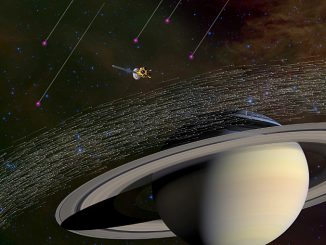
Cassini spacecraft samples interstellar dust near Saturn

NASA’s Cassini spacecraft has been in orbit around Saturn since 2004, studying the giant planet, its rings and its moons. Among the myriad microscopic grains collected by Cassini, a special three dozen stand out from the crowd. Scientists conclude these specks of material came from interstellar space — the space between the stars.

News

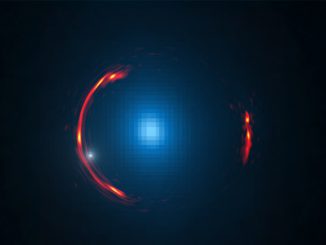
Dwarf dark galaxy hidden in ALMA gravitational lens image

Subtle distortions hidden in a stunning Atacama Large Millimetre/submillimetre Array (ALMA) image of the gravitational lens SDP.81 are telltale signs that a dwarf dark galaxy is lurking in the halo of a much larger galaxy nearly 4 billion light-years away. This discovery could help astronomers address important questions on the nature of dark matter.

Picture This

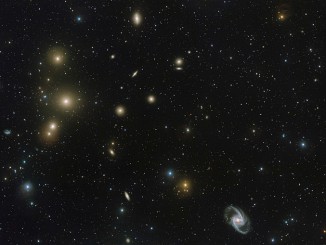
Gazing into the furnace: VST captures the Fornax Cluster

This new image from the VLT Survey Telescope (VST) at ESO’s Paranal Observatory in Chile captures a spectacular concentration of galaxies known as the Fornax Cluster, which can be found in the Southern Hemisphere constellation of Fornax (The Furnace). The cluster plays host to a menagerie of galaxies of all shapes and sizes, some of which are hiding secrets.

Picture This

Saturn’s past and present moons

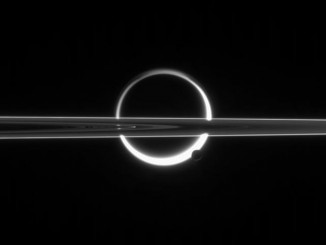
Saturn’s beautiful rings form a striking feature, cutting across this image of two of the planet’s most intriguing moons: Titan (diameter, 3,200 miles) and Enceladus (313 miles). The rings have been a source of mystery since their discovery in 1610 by Galileo Galilei, but there is not full agreement on how they formed.

News

Mysterious alignment of black holes discovered

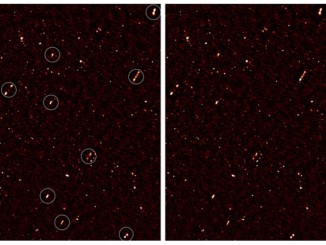
Deep radio imaging by researchers in the University of Cape Town and University of the Western Cape, in South Africa, has revealed that supermassive black holes in a region of the distant universe are all spinning out radio jets in the same direction — most likely a result of primordial mass fluctuations in the early universe.

News

Hot super-Earth atmospheres stripped by nearby host stars

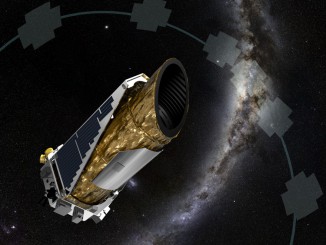
Astrophysicists at the University of Birmingham have used data from NASA’s Kepler space telescope to look at super-Earths, which are planets outside our solar system with a mass 1-10 times the mass of Earth. In particular, the researchers focused on hot super-Earths whose atmospheres have been stripped away by intense radiation from nearby host stars.