News

Mercury receives a meteoroid shower from Comet Encke

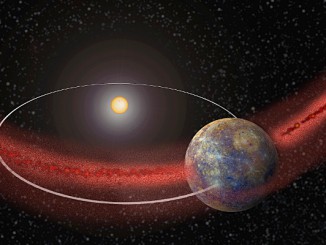
The planet Mercury is being pelted regularly by bits of dust from an ancient comet, a new study has concluded. Comet Encke has the shortest period of any comet, returning to perihelion every 3.3 years. The dust from the comet affects Mercury’s tenuous atmosphere and may lead to a new understanding on how these airless bodies maintain their ethereal envelopes.

News

Simpler planet test classifies 99 percent of all known exoplanets

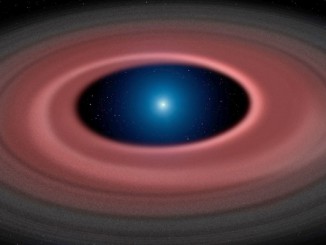
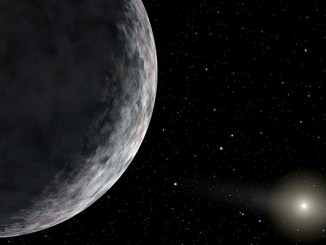
Nine years ago, the International Astronomical Union (IAU) defined what it takes to be a planet, but left the classification of exoplanets for future consideration. With exoplanet discoveries now numbering close to 5,000, UCLA professor of planetary astronomy Jean-Luc Margot describes a simple “planet test” that can be readily applied to bodies orbiting the Sun and other stars.

News

Mars’ moon Phobos is slowly falling apart

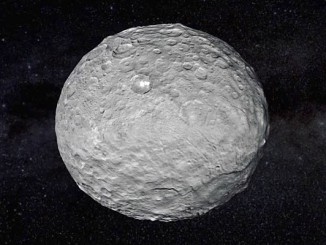
Orbiting a mere 3,700 miles above the surface of Mars, Phobos is closer to its planet than any other moon in the solar system. Mars’ gravity is drawing in the 17 × 14 × 11 mile body by about 6.6 feet (2 metres) every hundred years. The long, shallow grooves lining the surface of Phobos are likely early signs of its structural failure as scientists expect it to be pulled apart.

News

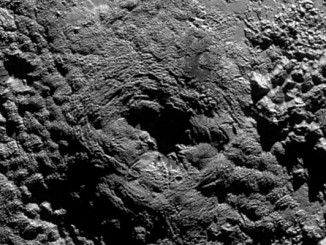
New Horizons finds possible ice volcanoes on Pluto

From possible ice volcanoes to twirling moons, NASA’s New Horizons science team is discussing more than 50 exciting discoveries about Pluto at this week’s 47th Annual Meeting of the American Astronomical Society’s Division for Planetary Sciences. The two cryovolcano candidates are large features measuring tens of miles across and several miles high.

News

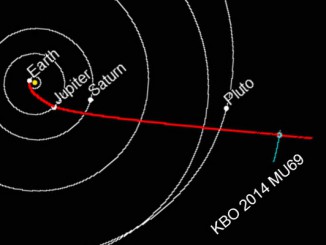
New Horizons’ manoeuvres put it on course for post-Pluto rendezvous

NASA’s New Horizons spacecraft, speeding toward deeper space at more than 32,000 miles per hour, has successfully performed a series of targeting manoeuvres that set it on course for a January 2019 encounter with Kuiper Belt object 2014 MU69. This ancient body is more than a billion miles beyond Pluto. The propulsive manoeuvres were the most distant trajectory corrections ever performed by any spacecraft.

News

NASA’s Swift spots its thousandth gamma-ray burst

NASA’s Swift spacecraft has detected its 1,000th gamma-ray burst (GRB). A GRB is a fleeting blast of high-energy light, often lasting a minute or less, occurring somewhere in the sky every couple of days. GRBs are the most powerful explosions in the universe, typically associated with the collapse of a massive star and the birth of a black hole.

Picture This

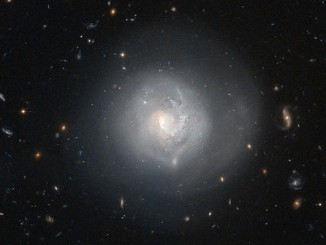
A galaxy at the centre of the Hubble Tuning Fork

Markarian 820, also known as Mrk 820, LEDA 52404 or IRAS F14379+3142, is a lenticular galaxy in the constellation Boötes, about 300 million light-years from Earth. Galaxies like this one are in the transition zone between ellipticals and spirals and lie right where the fork divides in American astronomer Edwin Hubble’s classification scheme of galaxies from 1926.