Eclipse

NASA science during the 9 March total solar eclipse

As the Moon slowly covers the face of the Sun on the morning of 9 March, a team of NASA scientists in Indonesia will be anxiously awaiting the start of totality. They plan to take 59 exposures of the Sun in just over three minutes, capturing data on the corona — the innermost parts of the Sun’s volatile, superhot atmosphere.

News

Mercury’s mysterious surface darkness revealed

Scientists have long been puzzled about what makes Mercury’s surface so dark. The innermost planet reflects much less sunlight than the Moon, a body on which surface darkness is controlled by the abundance of iron-rich minerals. These are known to be rare at Mercury’s surface, so what is the “darkening agent” there?

Picture This

Dying star offers glimpse of our Sun’s future

This planetary nebula is known as Kohoutek 4-55 (or K 4-55). It is one of a series of planetary nebulae that were named after their discoverer, Czech astronomer Luboš Kohoutek. Such a nebula is formed from material in the outer layers of a red giant star that are expelled into interstellar space when the star is in the late stages of its life.

Picture This

Hubble dares to look into Pandora’s Box

Peering deep into the early universe, this picturesque parallel field observation from the NASA/ESA Hubble Space Telescope reveals thousands of colourful galaxies swimming in the inky blackness of space in the constellation Sculptor. This spectacular skyscape was captured during the study of the giant galaxy cluster Abell 2744, otherwise known as Pandora’s Box.

Picture This

Methane snow on Pluto’s peaks

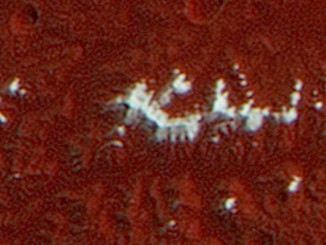
NASA’s New Horizons team has discovered a chain of exotic snowcapped mountains stretching across the dark expanse on Pluto informally named Cthulhu Regio. One of the dwarf planet’s most identifiable features, Cthulhu (pronounced kuh-THU-lu) is a bit larger than the state of Alaska and stretches nearly halfway around Pluto’s equator.

News

High-speed CHIMERA to scout for Kuiper Belt objects

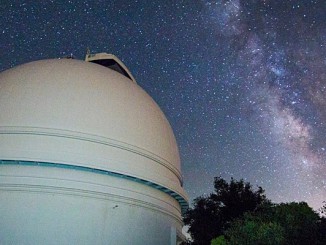
At the Palomar Observatory near San Diego, astronomers are busy tinkering with a high-tech instrument that could discover a variety of objects both far from Earth and closer to home. The Caltech HIgh-speed Multi-colour camERA (CHIMERA) system is looking for objects in the Kuiper Belt, the band of icy bodies beyond the orbit of Neptune that includes Pluto.

News

Hubble team breaks cosmic distance record

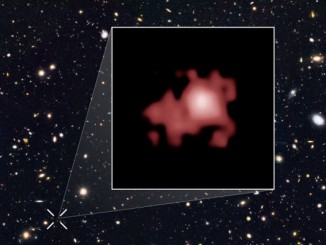
By pushing the NASA/ESA Hubble Space Telescope to its limits, astronomers have shattered the cosmic distance record by measuring the distance to the most remote galaxy ever seen in the universe. The galaxy, named GN-z11, has a redshift of 11.1, which corresponds to 400 million years after the Big Bang when the universe was only three percent of its current age.

News

Great tilt gave ancient Mars a new face

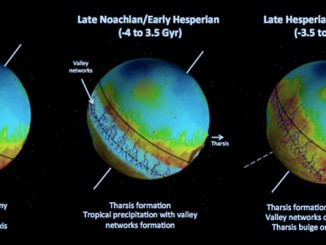
Mars hasn’t always looked like it does today. Some 3 to 3.5 billion years ago, the planet underwent a huge tilt of 20 to 25 degrees. The gigantic Tharsis volcanic dome, which started to form over 3.7 billion years ago, grew so massive that it caused Mars’ crust and mantle to swivel around, shifting the Tharsis dome to the planet’s equator.

News

Repeat fast radio bursts detected from same sky location

Astronomers for the first time have detected repeating short bursts of radio waves from an enigmatic source that is likely located well beyond the edge of our Milky Way galaxy. The findings indicate that these “fast radio bursts” come from an extremely powerful object which occasionally produces multiple bursts in under a minute.