News

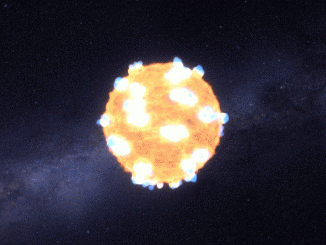
Astronomers glimpse supernova shockwave for the first time

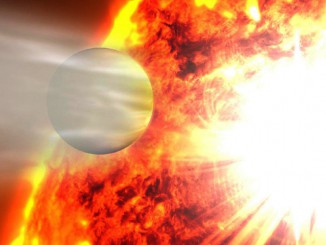
Astronomers have captured the earliest minutes of two exploding stars and for the first time seen a shockwave generated by a star’s collapsing core. The international team found a shockwave only in the smaller supernova — a finding that will help them understand these complex explosions that create many of the elements that make up the Earth and solar system.

Picture This

A cosmic kaleidoscope seen through multi-spectral eyes

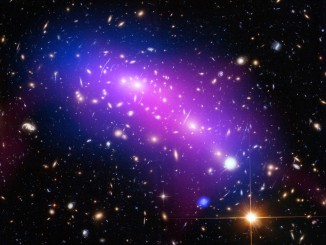
At first glance, this cosmic kaleidoscope of purple, blue and pink offers a strikingly beautiful — and serene — snapshot of the cosmos. However, this multi-coloured haze actually marks the site of two colliding galaxy clusters, forming a single object known as MACS J0416.1-2403 (or MACS J0416 for short), 4.3 billion light-years away from Earth.

News

A ‘tail’ of cometary twins buzzing Earth on 21-22 March

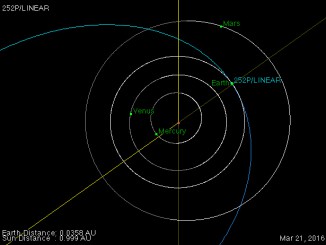
Comet 252P/LINEAR will zip past Earth on Monday, 21 March at a range of about 3.3 million miles. The following day, comet P/2016 BA14 will safely fly by our planet at a distance of about 2.2 million miles, or nine times the distance to the Moon. This will be the second closest flyby of a comet in recorded history next to comet D/1770 L1 (Lexell) in 1770.

News

Astronomers discover colossal ‘super spiral’ galaxies

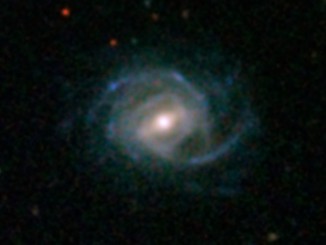
A strange new kind of galactic beast has been spotted in the cosmic wilderness. Dubbed “super spirals,” these unprecedented galaxies dwarf our own spiral galaxy, the Milky Way, and compete in size and brightness with the largest galaxies in the universe. The galaxies have long hidden in plain sight by mimicking the appearance of typical spirals.

Picture This

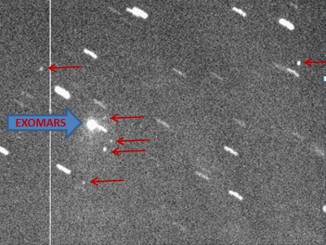
ExoMars spotted in space en route to Red Planet

On 14 March, the ExoMars spacecraft and Schiaparelli lander were lofted into orbit by a Proton rocket, starting a seven-month journey to the Red Planet. For the ExoMars launch, ESA’s near-Earth object (NEO) coordination centre in Italy organised a successful international campaign for ground-based optical observations of the departing spacecraft.

News

VLA reveals earliest stages of planet formation

New images of a young star called HL Tauri made with the Karl G. Jansky Very Large Array (VLA) reveal what scientists think may be the very earliest stages in the formation of planets. The scientists used the VLA to see unprecedented detail of the inner portion of a dusty disc surrounding the star, some 450 light-years from Earth.

News

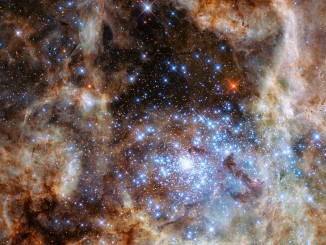
Hubble unveils monster stars in the Tarantula Nebula

Astronomers using the unique ultraviolet capabilities of the NASA/ESA Hubble Space Telescope have identified nine monster stars with masses over 100 times the mass of the Sun in the star cluster R136, located in the Tarantula Nebula within the Large Magellanic Cloud. This makes it the largest sample of very massive stars identified to date.